The digital front line is the Norwegian government’s name for the digital services that will become your first contact with the health service. First is a public AI service on Helsenorge, planned for spring 2027, that will answer questions about symptoms, health problems and test results. Here is what it is, what it may mean for people with kidney disease, and how Nyrami wants to contribute.
Many people no longer ask Google when their body feels wrong. They ask an AI service. The Norwegian government therefore wants to build a public AI service on Helsenorge, the national health portal, and is setting aside NOK 20 million for it in the 2027 state budget. The service is the first part of what the government calls a digital front line.
What is the digital front line?
The front line is where you first meet the health service, today usually your GP or the out-of-hours clinic. A digital front line means you can more often choose to make that first contact digitally, and get quality-assured help and guidance on Helsenorge before, between and after appointments.
According to the budget proposal, the digital front line may include several parts:
- A public AI service that answers health questions.
- Self-help and treatment tools, digital tools you can use yourself.
- Digital GP services, so GPs are easier to reach digitally.
- A municipal online doctor, being trialled in 15 municipalities, which gives around one million people access to a digital doctor’s appointment run by the public sector.
The government writes that many people can manage common and long-term health problems more on their own if they have good, evidence-based digital tools. The aim is help both to prevent and to live with illness throughout the course of treatment, and to free up time in a health service with fewer hands per patient.
What is the new AI service on Helsenorge?
It will be a chat service where you ask questions in your own words and get answers in a conversation. It is to be based on quality-assured information, adapted to the Norwegian health service, and able to answer questions about symptoms, health problems and test results.
The Norwegian Directorate of Health is building it with Norsk helsenett, the Norwegian Institute of Public Health and the Norwegian Medical Products Agency. It is planned for spring 2027. At first you will not need to log in, but logging in is a long-term goal. That could mean the service later sees your results and information, but nothing has been decided.
The service is a proposal in the state budget. The Storting, Norway’s parliament, adopts the budget in December 2026, so the money is not final yet.
Why now?
Because people already use AI for health questions. According to the government, one in three Norwegians uses international AI services for health questions every week. An international study found that one in five users of the large AI models got very problematic answers to health questions. The Minister of Health and Care Services, Jan Christian Vestre, says the authorities must deliver health security where people are.
The government also says it wants to work with private companies that have safe solutions on the market.
What does the digital front line mean for people with kidney disease?
Chronic kidney disease is lived mostly between check-ups. That is where you need to understand your test results, keep your blood pressure down, watch your fluid and know whether food suits your kidneys. The answers depend on your stage, on whether you are on dialysis or have had a transplant, and on the medicines you take.
A general AI service can be a good first place for questions such as “what does eGFR mean?” or “when should I see a doctor?”. But it will not necessarily know how much potassium is in the food you are holding in the shop, or how the advice changes from stage 3 to dialysis. That is why the budget also points to self-help tools as part of the front line: tools made for one disease and one everyday need.
In practice it means three things for you:
- Faster answers to simple questions, without waiting for an appointment.
- Safer than random AI answers, because the service is to be based on quality-assured information.
- Not a replacement for your kidney doctor or GP. Changes to medicines, diet and dialysis must always be agreed with your care team.
How do you use AI safely when you have kidney disease?
Until the Helsenorge service is ready, many people use the big AI services. That can be useful, as long as you are a little careful:
- Say which stage you are in, and whether you are on dialysis or have a transplanted kidney. The advice differs.
- Ask where the answer comes from, and check it against Norwegian sources such as Helsenorge, LNT or the kidney guide.
- Do not stop, start or change medicines because of an AI answer. Talk to your doctor first.
- Be careful about sharing your name, national identity number and other personal details in services you do not know.
- With serious symptoms, such as passing very little urine, severe swelling or difficulty breathing, call the out-of-hours service on 116 117. If life is at risk, call 113.
How does Nyrami want to contribute to the digital front line?
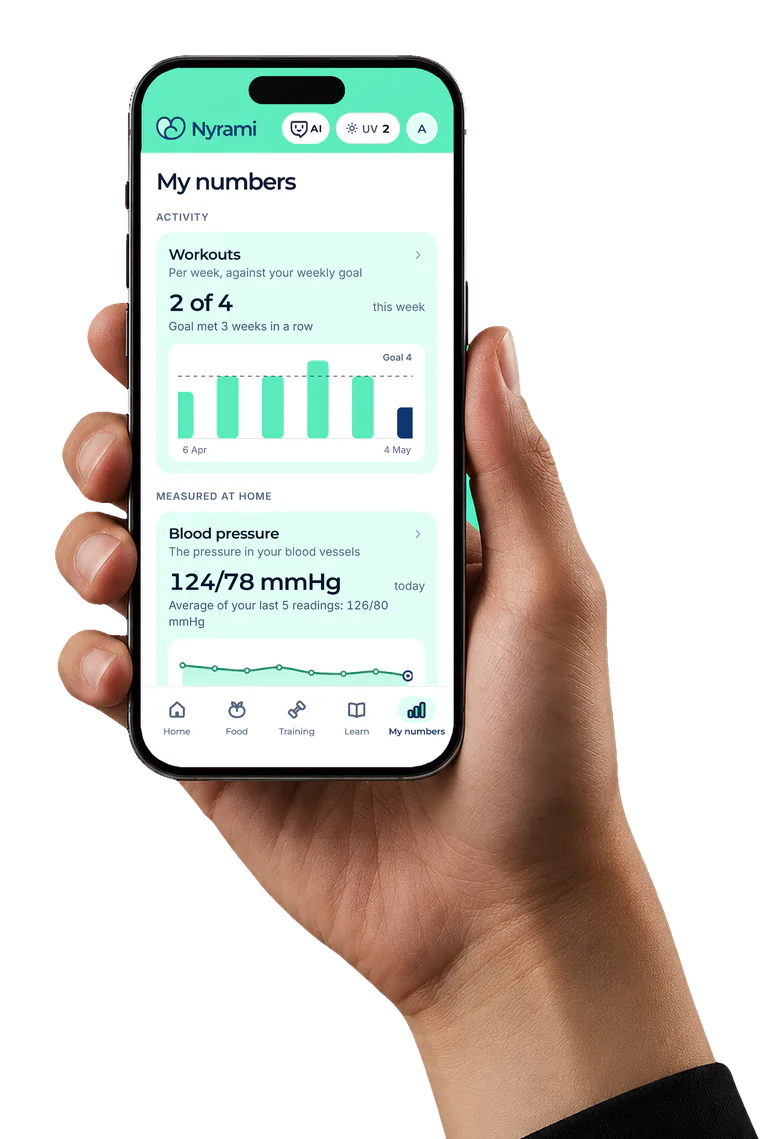
Nyrami is made for exactly the part of the front line that is about living with the disease at home. The app is built by a family that has lived with kidney disease for more than 20 years, and it does what you need between check-ups: it scans food in the shop with potassium, phosphorus and salt assessed for you, keeps track of blood pressure, weight, fluid and test results, and explains the disease in the kidney guide.
We want to contribute in four ways:
- With knowledge about kidneys. We are happy to share what we have built, from food data to the guides on test results, with the people building the digital front line, so people with kidney disease get precise answers.
- As a tool the front line can point to. Once the public AI service has answered the general questions, people with kidney disease should be able to find a tool made for them. We want to be one of them.
- By holding ourselves to the same standards. We show the sources under every guide, and we are working towards having all clinical content reviewed by health professionals. Our assistant, Ask Nyrami, gives guidance, not medical advice, and tells you when to contact a doctor.
- With what we learn from users. Every day we hear what people with kidney disease wonder about between check-ups, and we are happy to share that with the people building the services.
The government says it wants to work with private companies that have safe solutions. We take that as an invitation. If you work on this at the Directorate of Health, Norsk helsenett or a municipality, write to us at support@nyrami.com.
What happens next?
The Storting adopts the state budget in December 2026. If the money is approved, the AI service is planned to arrive on Helsenorge in spring 2027, with more parts of the digital front line to follow. We will update this guide when the service launches. Read also what the 2027 state budget otherwise means for people with kidney disease.
How Nyrami can help
While the digital front line is being built, you can already use the Nyrami app for what happens at home: scan food, track blood pressure, weight, fluid and test results, and find recipes and workouts suited to your kidneys. The app is free for iPhone and Android.