You cannot cleanse your kidneys, and you do not need to: the kidneys clean your blood themselves, around the clock. No tea, juice, cleanse or supplement does the job better, and some herbal remedies and large doses of vitamin C can cause harm. What protects the kidneys is good blood pressure and blood sugar, no smoking, little salt and water when you are thirsty.
Many people have tried a kidney cleanse, a cup of parsley tea or a glass of cranberry juice a day because they want to look after their kidneys. That is a good wish, and you have not done anything foolish if you have tried. But most of what is sold as cleansing does nothing for the kidneys, and some products can actually harm them. Here is what we know, and what really helps. The short version is in What is good for your kidneys?.
Can you cleanse your kidneys?
No, no tea, juice, cleanse or supplement cleanses the kidneys, and they do not need it. The kidneys are the cleaning system. Around 1,500 litres of blood pass through them every day, and 150 to 180 litres of that is filtered. Almost all of it is taken back up. What is left, around 1.5 litres of urine, carries away waste products, excess salt and water, and leftovers from medicines, according to Store medisinske leksikon (the Norwegian medical encyclopaedia).
So the kidneys do not need to be cleansed. They need blood vessels that are not damaged by high blood pressure and high blood sugar, and to be spared substances that strain them. When the kidneys fail, no cleanse can take over their work. Then it is medicines, and later dialysis or a new kidney, that help. Read more in Can kidney failure get better?.
Why does a kidney cleanse feel like it works?
A cleanse often feels like it works because you drink more than usual. Then you pass more urine, and it becomes paler. That shows you have taken in more fluid, not that your kidneys are cleaner. Many people also eat more healthily and cut out alcohol while on a cleanse, and that alone can make you feel better.
There is no good evidence that detox products improve kidney function. The only way to know how your kidneys are doing is a blood test and a urine test. No cleanse has been shown to change them for the better.
Can kidney cleanses and supplements harm your kidneys?
Yes, some can. The international guideline for chronic kidney disease, KDIGO 2024, says that kidney disease can be triggered or made worse by over the counter medicines, herbal remedies and dietary supplements, and asks doctors to ask their patients about them. Natural does not mean harmless. Many herbal remedies contain active substances that have never been tested in people with kidney disease.
Examples of products with reported kidney damage
Product
What has been described
A colon, kidney, liver and spleen "purifier" (CKLS)
Is on KDIGO's list of herbs and supplements with possible kidney damage
Chinese herbs containing aristolochic acid
Can cause serious kidney disease
Liquorice root, noni juice and St John's wort
Are on KDIGO's list of products with reported kidney damage
Large doses of vitamin C
Can cause calcium oxalate crystals in the kidneys. Swedish men who took vitamin C supplements got kidney stones about twice as often as men who took no supplements.
Creatine
Rare cases of kidney inflammation
The list is not complete. Source: KDIGO 2024 (chapter 4.1 and figure 45), Thomas et al. 2013 (Karolinska Institutet).
Another problem is that dietary supplements do not need to document effect, safety or quality, according to RELIS (the Norwegian medicines information centres), and some have contained illegal medicines. One example is Fortodol, sold in Norway as turmeric, which contained nimesulide, an anti-inflammatory drug of the same type as ibuprofen. Such drugs can lower kidney function, see Ibuprofen, paracetamol and the kidneys.
If you have kidney disease or take regular medicines, talk to your doctor or pharmacist before taking supplements or herbal remedies. That is also the advice from NHI (Norsk helseinformatikk).
Are cranberry, lemon, ginger or parsley tea good for your kidneys?
None of them cleanses the kidneys, but in normal amounts they are fine for most people. There is a difference between using something as food and flavour and taking it as a cure. Here is what we know about the four people ask about most.
Cranberry and the kidneys
Cranberry does not protect kidney function. A large Cochrane review from 2023 found that cranberry products probably give slightly fewer urinary tract infections in women who get them often, in children and after some procedures. At the same time, RELIS points out that cranberries contain oxalate, and that high doses over a long time can cause kidney stones. If you have had kidney stones, do not use cranberry as a cure. If you take warfarin, ask your doctor first, because cranberry can affect how thin your blood is. A glass of cranberry juice (200 ml) has around 155 mg of potassium.
Lemon and the kidneys
Lemon is fine for flavour, also in water, and can make it easier to drink enough and use less salt. But lemon water does not cleanse the kidneys or improve kidney function. A slice of lemon has around 20 mg of potassium, so it also suits most people who need to limit potassium.
Ginger and the kidneys
Ginger in food is fine: a tablespoon of grated ginger has less than 40 mg of potassium. There is no evidence that ginger or ginger shots protect or cleanse the kidneys. Ginger capsules as a supplement are something other than ginger in food, so ask a pharmacist first if you take regular medicines.
Parsley tea and "kidney tea"
There is no evidence that parsley tea or other 'kidney teas' cleanse or strengthen the kidneys. The tea gives you fluid, so you pass more urine, but that also happens when you drink water. Parsley as a herb and garnish is fine. If you buy ready made herbal blends, check the ingredients: some contain herbs with possible kidney damage, such as bearberry leaf (uva ursi), which is part of the purifier on KDIGO's list.
How can you make your kidneys work better?
Lost kidney function rarely comes back, but you can protect what you have and slow further loss. What works is not exciting, but it is documented: well controlled blood pressure and blood sugar, no smoking, little salt and physical activity. If you have kidney disease, medicines such as ACE inhibitors, ARBs and SGLT2 inhibitors like dapagliflozin (Forxiga) and empagliflozin (Jardiance) can slow the disease. That is the closest we get to something that helps the kidneys. Read more in Medicines for kidney disease.
Water is good, but more is not better. In a Canadian study, 631 people with stage 3 kidney disease were advised either to drink more or to drink as before. After one year there was no difference in kidney function. Drink water when you are thirsty, look for pale yellow urine, and follow any fluid limit from your doctor. Read more in Fluid balance in kidney disease.
What is the worst thing for your kidneys?
The worst thing for the kidneys over time is high blood pressure and diabetes that are not well controlled. They are the most common causes of severe kidney failure in Norway. Among the 398 people registered with stage 5 kidney failure in 2024, before dialysis or transplantation, the cause was blood pressure in thirty five per cent and diabetes in twenty one per cent, according to the Norwegian Renal Registry (Norsk nyreregister). Other things that strain the kidneys:
Smoking, which damages blood vessels, including those in the kidneys.
Regular use of anti-inflammatory painkillers (NSAIDs) such as ibuprofen (Ibux), diclofenac (Voltaren) and naproxen. KDIGO says that indiscriminate long term use is linked to a higher risk of kidney failure. Paracetamol is a safer choice for the kidneys.
Herbal remedies and high dose supplements without your doctor knowing, see above.
Becoming badly dehydrated, for example with vomiting and diarrhoea, especially if you also take NSAIDs or certain blood pressure medicines.
Can you prevent kidney stones by drinking more?
Yes, enough fluid is the most important thing you can do to avoid kidney stones. NHI advises people who have had kidney stones to drink so much that they pass at least 2 litres of urine a day, roughly one glass of water an hour. Up to one in ten men and one in twenty women get kidney stones during their lifetime, and half of them have a new attack within five years.
NHI also advises care with sugar and salt, and limiting foods high in oxalic acid, such as rhubarb, spinach, nuts and chocolate. The water does not cleanse the kidneys, but it dilutes the urine so crystals do not form as easily. If you have kidney failure, the advice to drink a lot does not automatically apply. Ask your doctor.
How do you know if your kidneys are working?
You find out how your kidneys are doing with two simple tests at your GP (fastlege): a blood test that gives your eGFR, a measure of how well the kidneys filter, and a urine test that measures albumin (uACR), a protein that leaks out when the kidney filters are damaged. Kidney disease rarely causes symptoms before function is greatly reduced, so you will not notice it yourself.
If you have diabetes, high blood pressure, heart or blood vessel disease, or kidney disease in the family, ask for both tests, ideally every year. Read more in How to detect kidney disease and eGFR normal range.
Contact your GP if you see blood in your urine. Contact the out of hours service (legevakt) on 116 117 if you get severe, wave-like pain in your side or back, fever with pain over the kidneys, or pass much less urine than usual. Call 113 in a life threatening situation.
How Nyrami can help
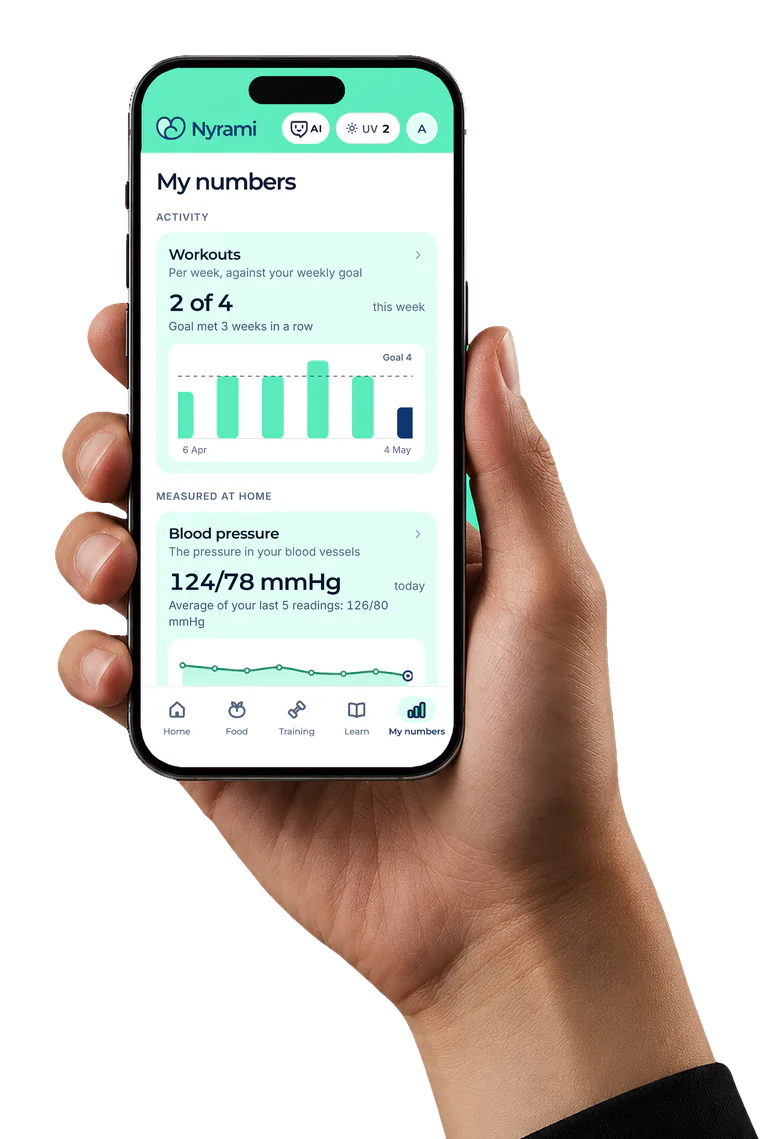
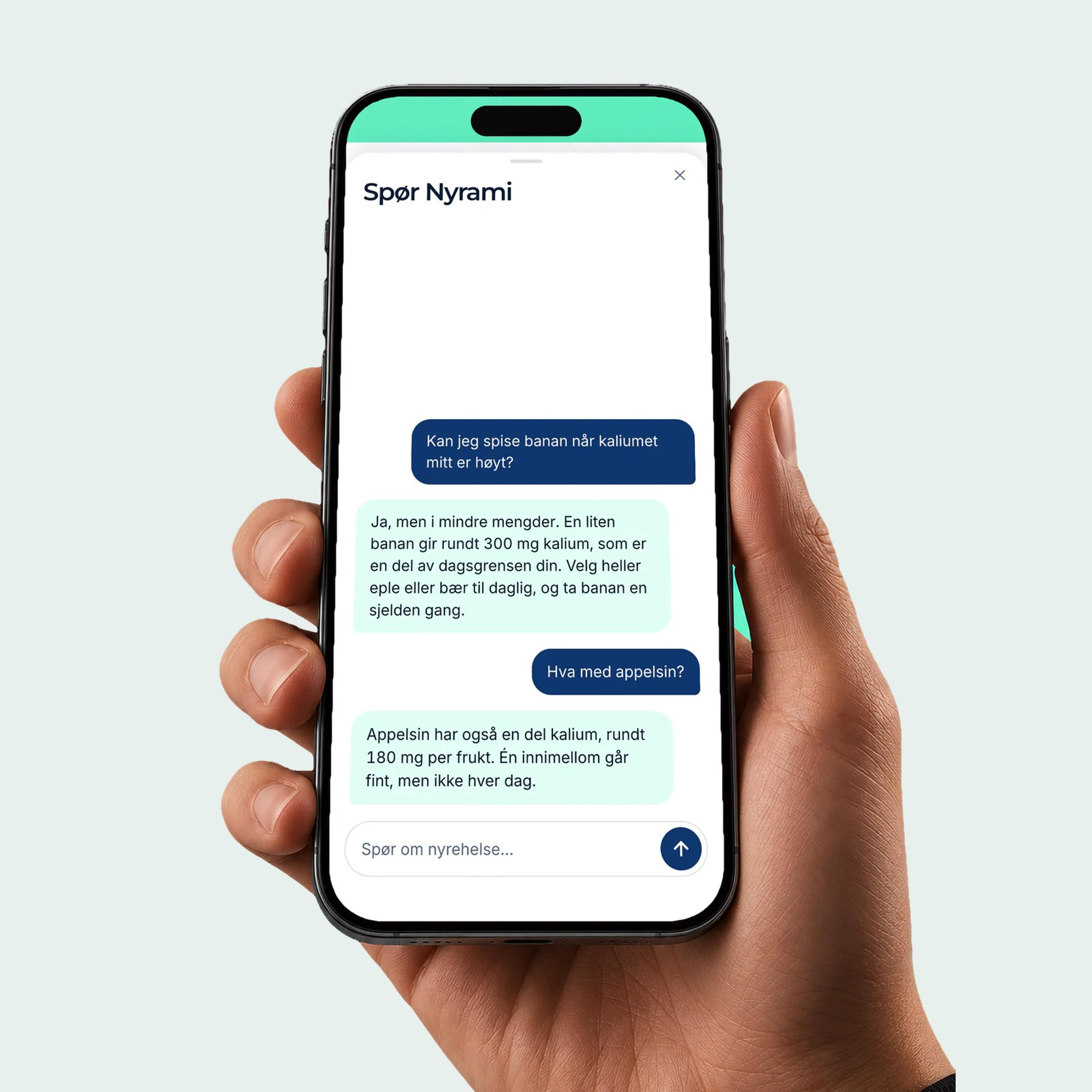
In the Nyrami app you can enter your eGFR, creatinine, albumin and blood pressure and have your values explained in words, so you can follow them over time. The food scanner reads the barcode and assesses potassium, phosphorus, sodium and protein for you, and in Learn you will find short articles on what actually helps. The app is free for iPhone and Android.
Turns the advice into something you can use in the shop and the kitchen: scan food and see potassium, phosphorus and salt assessed for you, and follow your numbers over time. Free on iPhone and Android.