Kidney failure life expectancy: can kidneys recover?
Acute kidney injury often gets completely or almost completely better. Chronic kidney disease (CKD) usually does not go away, but its progress can often be slowed so much that many people never need dialysis. How long people live depends mostly on stage, albumin in the urine, age and the heart. With dialysis or a new kidney, life can still be good.
This is often the first question after a diagnosis, and it is a hard question to ask, whether it is about yourself or someone you love. The answer is not the same for everyone. It depends on whether the kidney damage is acute or chronic, which stage you are in, what the cause is, and how well it can be treated. Here is what we know, without sugar coating it and without frightening you. The figures apply to groups, not to individuals. The disease itself is explained in Chronic kidney disease.
How long can you live with chronic kidney disease?
There is no single figure for how long people live with chronic kidney disease, because the course varies greatly. Many people with mild or moderate disease never need dialysis or a transplant and can live a long and good life. What matters most is the stage, the amount of albumin in the urine, the cause, your age and the state of your heart.
What the stage often means for the outlook
1 and 2 (with signs of damage)
What usually happens
Most people never develop kidney failure. The heart is often the biggest risk.
What matters most
Albumin in the urine, blood pressure and blood sugar
3a
What usually happens
Many people stay stable for many years.
What matters most
Albumin in the urine and how fast eGFR falls
3b
What usually happens
Higher risk for both the kidneys and the heart, and closer follow up.
What matters most
Albumin, the fall in eGFR and cardiovascular disease
4
What usually happens
Some stay stable for a long time, others move into stage 5. Planning of treatment starts.
What matters most
How fast eGFR falls, age and other illnesses
5
What usually happens
Dialysis, a new kidney or treatment without dialysis.
What matters most
Age, the heart, other illnesses and whether a new kidney is possible
What the stage often means for the outlook
Stage
What usually happens
What matters most
1 and 2 (with signs of damage)
Most people never develop kidney failure. The heart is often the biggest risk.
Albumin in the urine, blood pressure and blood sugar
3a
Many people stay stable for many years.
Albumin in the urine and how fast eGFR falls
3b
Higher risk for both the kidneys and the heart, and closer follow up.
Albumin, the fall in eGFR and cardiovascular disease
4
Some stay stable for a long time, others move into stage 5. Planning of treatment starts.
How fast eGFR falls, age and other illnesses
5
Dialysis, a new kidney or treatment without dialysis.
Age, the heart, other illnesses and whether a new kidney is possible
A rough picture of groups, not a prognosis for you. Source: KDIGO 2024 (the risk chart), Norsk helseinformatikk.
For many people the heart is a bigger threat than the kidneys. People with chronic kidney disease have a clearly higher risk of heart attack and stroke than others. That is why blood pressure, cholesterol, stopping smoking and physical activity matter as much for life expectancy as the measures for the kidneys themselves. Albumin in the urine says a lot about the risk, see Protein in urine and The kidneys and the heart.
In stages 3 to 5, the international KDIGO guideline recommends that your doctor uses a calculation of your risk of kidney failure over the next two and five years (the KFRE, Kidney Failure Risk Equation). Feel free to ask your doctor about this. A figure for you is worth more than averages from the internet.
How long can you live with stage 4 and 5 kidney failure?
There is no single figure for stages 4 and 5 either. How fast people move from stage 4 to 5 varies a lot: some are stable for years, while others decline faster. Among the oldest, many die of other causes before the kidneys fail completely. In stage 5, life expectancy depends mostly on which treatment you receive, your age and the state of your heart.
The kidneys can recover after an acute injury, but in chronic kidney disease lost kidney tissue does not grow back. Each kidney is made up of a very large number of tiny filters. When some of them are lost, the ones that remain work harder. That keeps you well for a long time, but it is also the reason the disease often slowly progresses.
That does not mean everything is decided. Treatment aims to spare the filters that remain, so that they last as long as possible. That is where blood pressure, blood sugar, salt and kidney protecting medicines come in.
Can you recover from kidney failure?
Yes, if it is acute kidney injury. It comes on over hours or days, for example with a serious infection, dehydration or certain medicines, and many people get back most or all of their kidney function when the cause is treated. Some are still left with permanently reduced function afterwards.
Chronic kidney disease develops over months and years and usually does not go away. No medicine or diet cures it, and nothing “cleanses” the kidneys. But the disease can be slowed, and many people live with stable kidney function and few problems for many years. This is especially true when it is found early.
Is kidney failure fatal?
Stage 5 kidney failure is life threatening without treatment, because the body cannot get rid of waste products, salt and water. But dialysis and transplantation can take over the work of the kidneys. At the end of 2024, 5,517 people in Norway were living with such treatment, according to the Norwegian Renal Registry (Norsk nyreregister): 1,836 on dialysis and 3,681 with a working transplanted kidney.
A new kidney gives the best outlook and a near normal life, but requires anti-rejection medicines for life and regular check ups. In 2024, 255 kidney transplants were carried out in Norway, 71 of them with a kidney from a living donor, according to Helsedirektoratet (the Norwegian Directorate of Health). Dialysis is a more demanding treatment with a higher risk of complications, and the wait for a new kidney means some people are on dialysis for a long time. Read more in Dialysis, Kidney transplant and Donating a kidney.
How long can you live on dialysis?
It varies a lot with age and other illnesses. Many people live for many years on dialysis, younger people live longer on average than older people, and a new kidney usually gives a better outlook for those who can have one. Figures from the Norwegian Renal Registry and what affects them are in How long can you live on dialysis?.
How long does a new kidney last?
Five years after the transplant, about nine in ten kidneys from living donors and about eight in ten from deceased donors are still working, according to the curves in the Norwegian Renal Registry annual report for 2024. Many kidneys last much longer, but not always for life. Cristian, whose experience has helped shape Nyrami, received his first new kidney in 2006, and it lasted nine years. Read Cristian's story and more about Kidney transplant.
How long can you live without dialysis?
How long you can live without dialysis depends on how much kidney function is left and how fast it falls. Some people have stable, reduced kidney function for many years. When the kidneys fail completely, life without dialysis or a new kidney will eventually come to an end, but the time varies greatly from person to person.
For the oldest and sickest, dialysis does not always mean a longer life. In a review of studies of older people, those who chose not to have dialysis lived a median of six months to two and a half years, against eight months to just over five years for those who chose dialysis, but those who chose dialysis were younger and fitter. A Cochrane review from 2025 rates the evidence as very uncertain. Treatment without dialysis (conservative care) focuses on relieving problems such as nausea, itching and swelling with medicines and diet, and on giving the best possible quality of life. More about this choice and the last phase is in End-stage kidney failure.
What can you do yourself to slow the disease?
You can do a lot yourself to slow chronic kidney disease. The most important things are keeping your blood pressure down, taking the medicines you have been prescribed, eating little salt, stopping smoking and staying active. If you have diabetes, well controlled blood sugar is one of the most important things you can do for your kidneys.
Keep your blood pressure below the target your doctor has set, for most people below 130/80. See Blood pressure and the kidneys.
It is completely normal to feel scared, sad or angry after a kidney diagnosis. Many people find it helps to understand their values, to have someone to talk to and to take one step at a time. Write down your questions before your appointment, and feel free to bring someone you trust.
For you as a family member: The choice between dialysis, a new kidney and treatment without dialysis is best made together, with the kidney specialist. Helsenorge has a decision aid for end-stage chronic kidney disease (in Norwegian) that you can go through at home before the conversation. When the person you love consents, you have a right to information about their health. Read more in Supporting someone with kidney disease.
The Norwegian association for kidney patients and transplant recipients (Landsforeningen for nyrepasienter og transplanterte, LNT) is a patient organisation where you can meet others in the same situation. Also read Cristian's story about what it is like to live with kidney disease.
How Nyrami can help
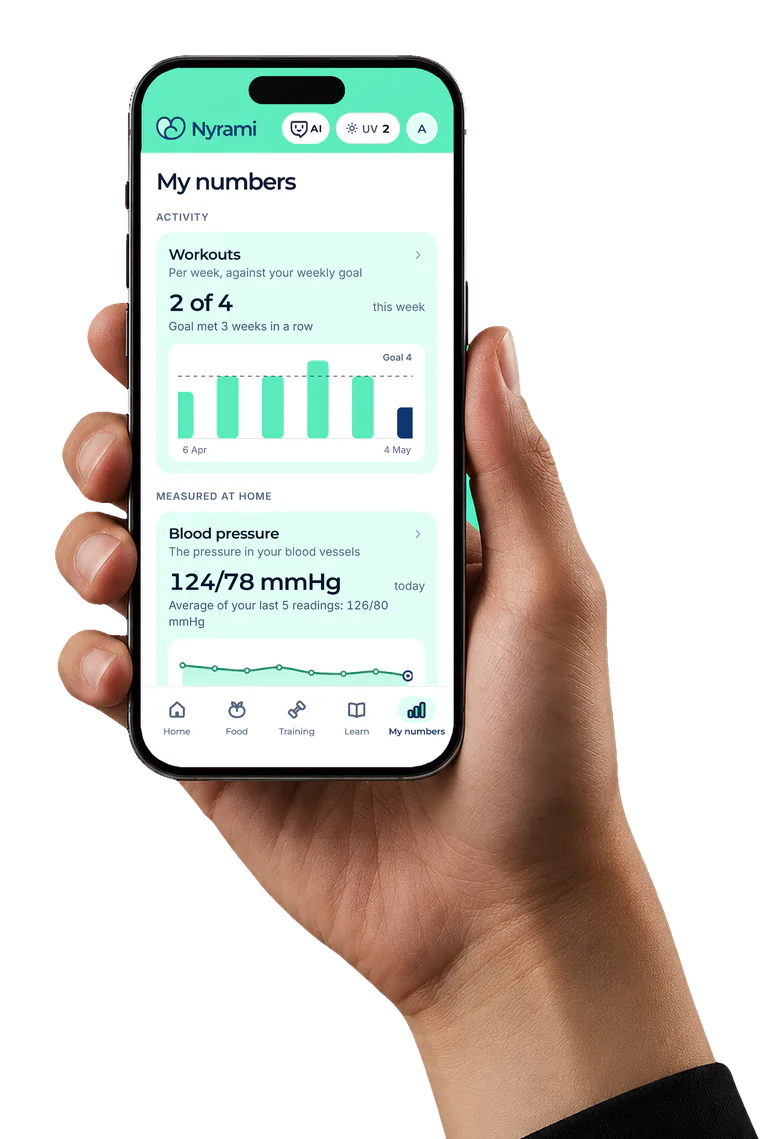
In the Nyrami app you see your values, such as eGFR, creatinine, albumin and blood pressure, explained in words and over time, so you know what to ask your doctor. The app also has recipes assessed per portion, a food scanner and workouts at your own pace, for the things you can do yourself. It is free for iPhone and Android.
Turns the advice into something you can use in the shop and the kitchen: scan food and see potassium, phosphorus and salt assessed for you, and follow your numbers over time. Free on iPhone and Android.