Caring for someone with kidney disease: help and rights
As a family carer, you help most by understanding the disease together with the person you love, supporting without taking over and looking after yourself. With consent you have a right to information, the municipality must offer support when care is heavy, and NAV has schemes for time off work.
When someone you love gets kidney disease, you often become part of their treatment without asking to be. You cook, drive to appointments, keep track of medicines and worry. This guide is for partners, children, parents and friends: how you can help, what rights you have in Norway, and where you can get support yourself.
What does kidney disease do to family life?
Kidney disease can change food, holidays, finances, roles and moods in a family, and how much depends on the stage. Many people with chronic kidney disease (CKD) live for a long time with few problems. With severe kidney failure and dialysis there is more: fixed treatment days, dietary advice, a fluid limit and tiredness. It is common for family members to feel worry, anger, grief and guilt.
LNT (the Norwegian association for kidney patients and transplant recipients) advises families to talk about how each of you is experiencing the situation, to share tasks deliberately and to talk about more than the illness. It is fine to laugh and have good times, even in the middle of the hard parts. Read more in Chronic kidney disease and Life on dialysis.
How can you help with food, fluids and medicines?
You help most by supporting, not controlling. The person who is ill owns their treatment and makes their own decisions. Ask what they would like help with, and agree who does what. That protects their independence and makes things easier for both of you over time.
Food: Dietary advice depends on the stage and the blood tests. Many people mainly need less salt and fewer ready meals, which is healthy for the whole family. Potassium and phosphorus only need limiting when the tests show it. See Food with kidney failure, and look up more than 2,100 foods in the food list.
Fluids: On dialysis and with severe kidney failure, many people have a limit on how much they can drink. Help spread drinks over the day if they want, but avoid counting every glass for them. See How much should you drink?
Medicines: Help keep an up to date medicine list and a pill organiser, and check with a doctor or pharmacist before anything new is taken, including over the counter products. Ibuprofen (Ibux) and other anti-inflammatory painkillers should be avoided. Ask for a written plan for which medicines to pause during vomiting, diarrhoea or fever. See Medicines and kidney disease.
At the appointment
Come along if the person who is ill wants you to. Two people hear more than one, and you can take notes. Write your questions down in advance, for example:
What stage is the disease at, and how has eGFR changed?
What should we do with the medicines during acute illness?
What do the test results mean for food?
Who do we call if something happens between check-ups?
Call the out-of-hours medical service (legevakt) on 116 117 if the person you care for passes very little urine, becomes confused or unusually drowsy, gets short of breath or swells up quickly. The same applies to sudden muscle weakness or an irregular pulse in someone who has had high potassium. If life is in danger, call 113.
What rights do you have as a family member?
As a family member you always have a right to general information and guidance from health services. With the consent of the person who is ill, the closest relative also has a right to information about their health and treatment. The patient decides who their closest relative is. If they can no longer make decisions about their care, the closest relative gains a right to information and to take part.
The Norwegian Directorate of Health’s guide on family members (Pårørendeveileder, in Norwegian) describes what health services must do: involve family members, find out what you need, and offer support and guidance, including to children. You can refer to it if you feel left out.
The municipality must offer necessary support to people with particularly heavy care responsibilities, including training and guidance, respite care and a carer’s allowance (omsorgsstønad) (Health and Care Services Act, section 3-6). Nobody has a statutory right to the carer’s allowance itself, but every municipality has the scheme and must assess your needs together with you.
If you are employed, you have a right to up to 10 days of leave a year to give necessary care to a parent, spouse, cohabiting partner or registered partner (Working Environment Act, section 12-10). Whether you are paid depends on your employment contract or collective agreement.
What financial support can you get as a family carer?
There are several schemes, but the conditions are strict, and most only apply when care is extensive or long term. Some are paid to you, others to the person who is ill. Always check the conditions on nav.no and with your municipality before you plan around them.
Schemes that may apply with kidney disease in Norway
Carer’s allowance (omsorgsstønad)
From
Municipality
May apply when
You do particularly heavy care work that the municipality would otherwise have had to do
Respite care, training and guidance
From
Municipality
May apply when
Care is heavy over time
Care benefit at the end of life (pleiepenger i livets sluttfase)
From
NAV
May apply when
You are off work to care for a close relative at home in their last period of life, for up to 60 days
Attendance allowance (hjelpestønad)
From
NAV, to the patient
May apply when
The patient needs long term private supervision and care, for example from family
Basic benefit (grunnstønad)
From
NAV, to the patient
May apply when
The illness causes lasting extra costs, for example for transport
Pension credits for care (omsorgsopptjening)
From
NAV
May apply when
You provide care at least 22 hours a week for at least six months of the year
Schemes that may apply with kidney disease in Norway
Scheme
From
May apply when
Carer’s allowance (omsorgsstønad)
Municipality
You do particularly heavy care work that the municipality would otherwise have had to do
Respite care, training and guidance
Municipality
Care is heavy over time
Care benefit at the end of life (pleiepenger i livets sluttfase)
NAV
You are off work to care for a close relative at home in their last period of life, for up to 60 days
Attendance allowance (hjelpestønad)
NAV, to the patient
The patient needs long term private supervision and care, for example from family
Basic benefit (grunnstønad)
NAV, to the patient
The illness causes lasting extra costs, for example for transport
Pension credits for care (omsorgsopptjening)
NAV
You provide care at least 22 hours a week for at least six months of the year
Source: NAV and Helsenorge, October 2026. Conditions change, so check nav.no and your municipality.
The end-of-life care benefit requires that you have had earned income, and that the person is cared for in a private home, not in hospital or a nursing home. Several people can share the 60 days. It may apply, for example, if the person you love stops dialysis and wants to be at home for the last period. The attendance allowance does not cover what home nursing already does, and for basic benefit towards a special diet, NAV requires that a specialist has made the diagnosis and described the diet.
Dialysis and transplantation: what does it mean for the family?
Dialysis and transplantation take a lot of time and travel, and the family often comes along. Haemodialysis in hospital usually takes around four hours, three times a week, plus the journey. Home dialysis, either peritoneal dialysis or home haemodialysis, gives more freedom, but requires training. Around a quarter of dialysis patients in Norway have dialysis at home, according to the Norwegian Directorate of Health.
Travel to dialysis and check-ups is covered under the patient travel scheme (pasientreiser). If the patient needs someone with them for health reasons, the treatment centre must confirm it, and then your travel as a companion is also covered, and in some cases lost earnings. Children under 18 always have a right to a companion. If you as a family member are called in for training, for example before home dialysis, your travel may also be covered.
All kidney transplants in Norway are carried out at Oslo University Hospital, Rikshospitalet, and most patients have check-ups there for the first eight weeks. If you live far away, the transplant recipient can stay at a hotel, and family members can stay with them. According to Oslo University Hospital, family members then pay their own travel and accommodation.
When the conversation turns to choices and prognosis
Many families eventually need to talk about whether or not to have dialysis, and about the last part of life. It is fine to ask the kidney specialist directly what the figures mean for you, and to ask for another conversation. The patient decides, but may want you there. Read more in End-stage kidney failure, How long can you live on dialysis? and Kidney failure in older people.
What about the children in the family?
Children notice when someone in the family is seriously ill, and they have their own rights. Section 10 a of the Health Personnel Act says that health professionals must help look after the children and siblings under 18 of patients with serious illness, for example by talking with the patient about what the child needs and giving the child information adapted to them. Hospitals must have staff responsible for children who follow this up. Feel free to ask the care team to talk with the children together with you.
If it is your child who has kidney disease, you may be entitled to care benefit (pleiepenger) from NAV when the child is under 18, needs continuous supervision and care and is followed up by specialist health services. You can also apply for extra days of care leave (omsorgspenger) when the child has a chronic illness, and for training allowance (opplæringspenger) when you need to learn to care for the child at an approved health institution, also after the child turns 18. LNT has family contacts for parents.
What do you do when you are worn out as a carer?
It is common to become exhausted as a family carer, and it does not mean you are doing anything wrong. Research shows that many family carers struggle with sleep and low mood, and that those who manage to keep part of their own life more often stay well themselves, writes NHI (in Norwegian). If you are tired over a long time, sleep badly and lose the joy in things you like, you need help yourself.
Tell your own GP how you are doing. Your health matters too.
Apply to the municipality for respite care or a carer’s allowance, and describe what you do and how much time it takes.
Share tasks within the family, and say yes when someone offers help.
Call the family carers’ helpline (Pårørendelinjen) on 90 90 48 48 if you need someone to talk to.
Where can family members get help?
LNT has peer supporters who have lived with kidney disease, a transplant or given a kidney themselves, and separate contacts for family members, donors and parents. Phone 23 05 45 50, or see LNT’s page for family members (in Norwegian).
Pårørendelinjen, the helpline run by the national centre for family carers (Pårørendesenteret), answers on 90 90 48 48 and by chat on weekdays, free of charge. Pårørendesenteret also has courses and e-learning for all family carers, whatever the diagnosis.
Kidney school and learning and coping centres: many hospitals run courses on kidney disease for patients and family members together. They usually require a referral, so ask the kidney outpatient clinic.
The municipality for home care, respite care and the carer’s allowance, and the GP (fastlege) for both the patient and you.
Helsenorge has an overview of family members’ rights (in Norwegian), and the patient and user ombudsman (pasient- og brukerombudet) can help if you want to appeal a decision.
How Nyrami can help
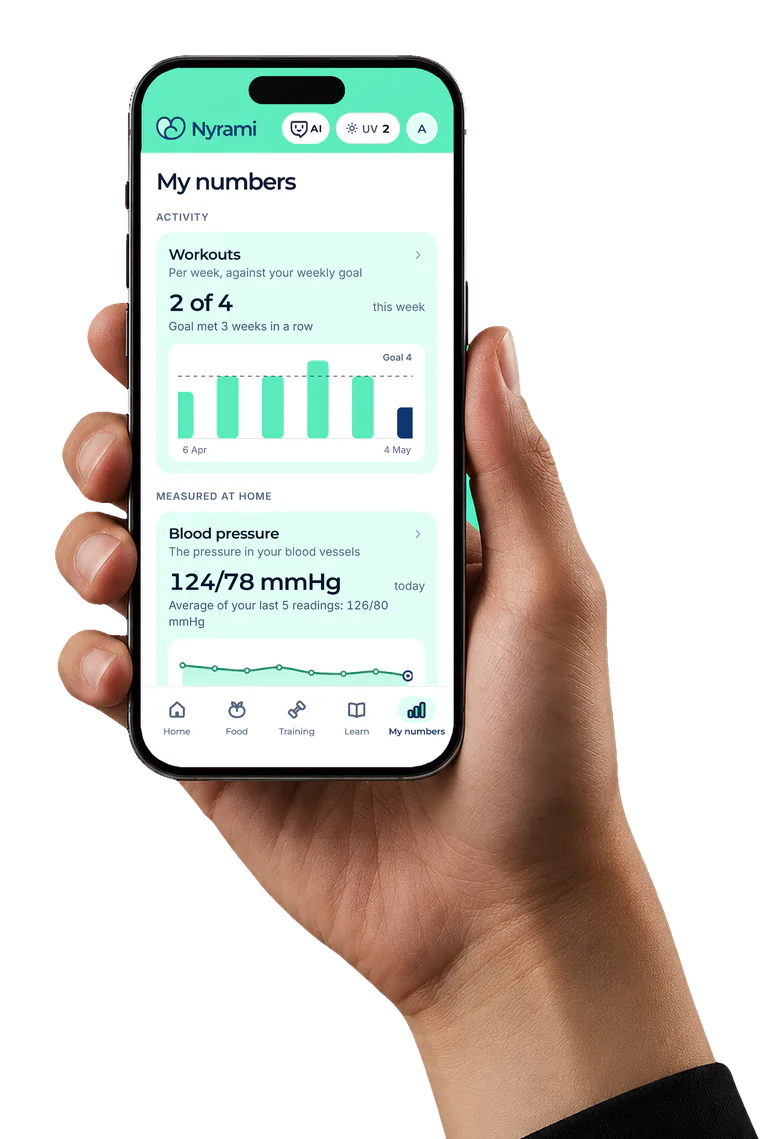
Many people use the Nyrami app together before an appointment: values such as eGFR, creatinine, albumin and blood pressure are in one place, explained in words and over time. The food scanner assesses potassium, phosphorus, sodium and protein for you, including when you are the one doing the shopping. The app is free for iPhone and Android.
Turns the advice into something you can use in the shop and the kitchen: scan food and see potassium, phosphorus and salt assessed for you, and follow your numbers over time. Free on iPhone and Android.