Donating a kidney: what it is like to be a living donor
Healthy adults over 18 can be assessed as a kidney donor for a family member or close friend. The risk is small but not zero: a slightly higher risk of high blood pressure and kidney failure later in life. You are examined thoroughly, lost income is covered, and you can withdraw at any time.
Being asked to give a kidney, or wondering whether to offer one, is a big question. Many people who receive a new kidney describe it as getting their life back. But the decision must be yours, made with good information and without pressure. Norway has many living donors: in 2024, 71 of 255 transplanted kidneys came from living donors (Norwegian Directorate of Health), and in 2025, 70 people gave a kidney to a family member or close friend (Stiftelsen Organdonasjon, the Norwegian organ donation foundation).
Who can donate a kidney?
In Norway anyone over 18 can be assessed as a living kidney donor, and there is no upper age limit. You need good physical and mental health. The donor can be a parent, sibling, child, grandparent, aunt, uncle, cousin, spouse, partner, in-law or close friend. It is not possible to give a kidney anonymously to a stranger.
Some conditions rule you out, including diabetes, high blood pressure, kidney disease (for example repeated kidney stones), heart disease, cancer and chronic infections. A BMI (body mass index) that is too high also rules you out: the limit is 31 for men and 32 for women, and 30 for everyone under 30. If you are related, you may share an inherited tendency to the same kidney disease. That is one of the reasons the assessment is so thorough. Read more in Is kidney disease hereditary?.
Does the donor need the same blood type?
No, you do not need the same blood type, but your blood types must be compatible. Blood type O can give to everyone, while someone with blood type O can only receive a kidney from O. Tissue type also matters: a blood test called a crossmatch shows whether the recipient has antibodies against your tissue. If so, you may not be a match even though your blood types are.
Which blood types match in kidney donation?
Donor blood type
Can give to a recipient with blood type
O
O, A, B and AB
A
A and AB
B
B and AB
AB
AB only
Source: National Kidney Foundation. With pre-treatment of the recipient, a transplant can sometimes go ahead even if the blood types do not match (Oslo University Hospital).
If you do not match, that is not necessarily the end. Sometimes the recipient can have treatment that removes the antibodies against your blood type, so the transplant is still possible. Norway also takes part in STEP, a Nordic kidney exchange scheme that started in 2019. It links pairs who do not match: you give your kidney to a stranger who matches, and the person you love receives a kidney from another donor in the scheme.
What are the risks of donating a kidney?
The risk of donating a kidney is small, but it is not zero. In large international registries, about three in ten thousand donors die in connection with the operation. According to Rikshospitalet's information booklet from 2019, no donors in Norway had died in connection with the operation. Serious complications affect fewer than three in a hundred.
Short-term risks
Wound infection: one to four in a hundred.
Urinary tract infection after the urinary catheter: about five in a hundred.
Blood clot: fewer than two in a hundred.
Switching to open surgery: fewer than one in a hundred.
Many people feel tired and have less energy in the first six months, and some have pain in the scar for weeks or months.
Long-term risks
The remaining kidney increases its work, and after a short time you have about three quarters of the kidney function you had with two kidneys. The risk of kidney failure later is higher than for equally healthy people who have not donated, but it is still low:
A large American study estimated that about nine in a thousand donors develop serious kidney failure during their lifetime, compared with just over one in a thousand equally healthy people who did not donate. In the population as a whole the figure is more than three in a hundred.
In a Norwegian study of 1,901 donors, nine developed serious kidney failure over about 15 years, roughly five in a thousand. All nine were related to the recipient, and the researchers think heredity may have played a part.
Donors develop high blood pressure over the years slightly more often than people of the same age who have not donated.
Women who become pregnant after donating a kidney more often get high blood pressure or pre-eclampsia: in a Canadian study it happened in about one in ten pregnancies, compared with one in twenty among equally healthy women. Most pregnancies went well.
Norwegian donors live longer on average than the rest of the population, partly because only healthy people are approved. Compared with equally healthy people who have not donated, however, a Norwegian study found a slightly higher risk of death, mainly from heart disease, over many years. That is why all donors are followed up for the rest of their lives.
How are you assessed as a donor?
The assessment is done by a kidney specialist at a hospital near you, preferably a different doctor from the one who treats the recipient. First you are told about the risks and decide whether to go on. Then your blood type and tissue type are tested, and finally your health:
Blood and urine tests and an accurate measurement of kidney function.
A CT scan of the kidneys and urinary tract.
A chest X-ray, ECG and possibly an exercise test of the heart.
A lung function test (spirometry) and an assessment by a physiotherapist.
A conversation about your social and financial situation.
The doctor then sends an application to Rikshospitalet, where a team assesses it. This often takes one to two months, and the whole process usually takes several months. From the end of the assessment to the operation takes from a week to two or three months, and the date is planned with you. The assessment can also uncover illness you did not know about.
What are the operation and the recovery like?
All kidney donations in Norway are done by keyhole surgery at Rikshospitalet. The surgeon uses two or three small openings and a 6 to 9 centimetre cut low on the abdomen, a bikini line incision, through which the kidney is removed. You are admitted two to three days before and usually go home five to seven days after the operation.
Nausea in the first days and a sluggish bowel are common. At home you should avoid heavy lifting and sit-ups for six to eight weeks; a couple of light shopping bags is fine. If you have small children, plan for help, because you cannot lift them as usual. Some people feel low for a few days after getting home. It is a normal reaction and usually passes on its own.
Sick leave and money
The aim is that you as a donor should not lose money. Most people are on sick leave for six to eight weeks. As an employee you receive sickness benefit from NAV from the first day, so your employer does not pay for the first 16 days. The right to sickness benefit also applies while you are being assessed as a donor (National Insurance Act sections 8-4 and 8-17).
Lost income not covered by sickness benefit, for example if you earn more than 6G (six times the national insurance basic amount), are self-employed without extra insurance or lose a planned summer job, is covered by the recipient's health trust. Clarify this before the operation.
Travel to the assessment, the operation and check-ups is covered by Pasientreiser (patient travel).
Patient charges related to the donation should, as a rule, not be paid by you. Keep all receipts.
Childcare and help at home must be agreed with the recipient's health trust before you are admitted.
The social worker, nurse or doctor at the hospital assessing you will help with the applications, but raise the question yourself. The law forbids buying and selling organs, and you must not accept payment from the recipient.
What is it like to live with one kidney afterwards?
Most donors live an ordinary life. According to Rikshospitalet, having given a kidney does not affect your ability to work or to be physically active. When Rikshospitalet followed up Norwegian donors over time, almost nine in ten said it had been a positive experience, and nineteen in twenty would do it again.
You will have check-ups with the kidney specialist after six weeks, three months, six months and one year, and then you are followed up for the rest of your life. Blood pressure, kidney function (eGFR) and albumin in the urine are the most important values to follow. Read more in Can you live a normal life with one kidney?.
It can also be emotionally demanding. Some find it hard that attention goes to the recipient, and a sense of debt can make the relationship between you more difficult. If the new kidney does not work, it is never the donor's fault.
How do you ask, and how do you say no?
There is no right way to ask. Many people who need a kidney find it easier to talk about their situation and share information, for example this page, than to ask someone directly. Family and friends can then contact the kidney specialist themselves if they want to know more, without anyone waiting for an answer.
Nobody should be pressured into giving a kidney, and you have the right to say no for any reason. You can withdraw at any time, even late in the assessment. Your conversations with the kidney specialist and the results of your tests are confidential from the recipient. That also applies if you are not approved, and why.
For the person who needs the kidney, it is common to feel guilt and worry: is it right to accept such a big gift, and what if the donor becomes ill? It often helps to talk about it, with the donor, the kidney specialist, the social worker or someone who has been in the same situation. LNT (the Norwegian association for kidney patients and transplant recipients) has peer supporters who have given a kidney themselves. Also read about kidney transplantation and about being a family member of someone with kidney disease.
How Nyrami can help
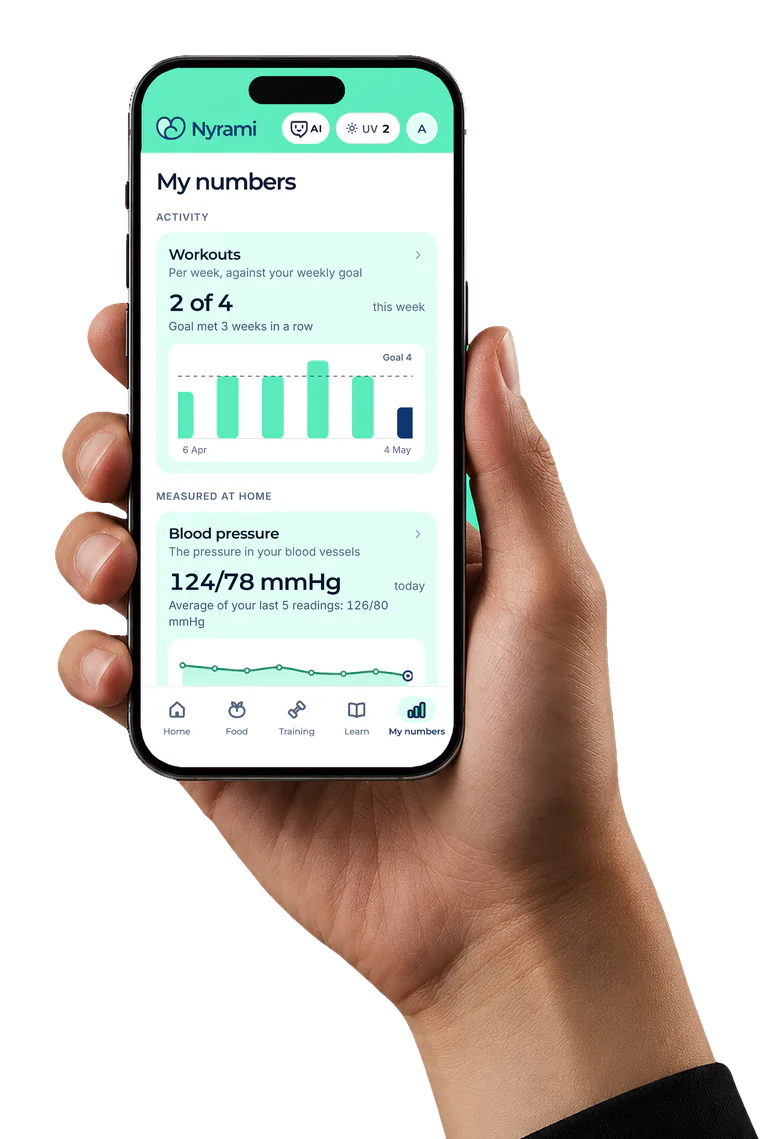
If you have given a kidney, you can use the Nyrami app to follow your values over time, such as blood pressure, eGFR and albumin in the urine, so you see the trend between check-ups. The food scanner assesses salt, among other things, in what you buy, and the workouts with video suit you when you are getting going again after the operation. The app is free to download for iPhone and Android.
Turns the advice into something you can use in the shop and the kitchen: scan food and see potassium, phosphorus and salt assessed for you, and follow your numbers over time. Free on iPhone and Android.