Is kidney disease hereditary? PKD, Alport and family
Most kidney disease is not inherited, but caused by high blood pressure and diabetes, which often run in families. Some kidney diseases are passed on directly, especially polycystic kidney disease and Alport syndrome. If a close relative has kidney disease, you should have your blood pressure, blood and urine checked.
When someone in the family gets a kidney diagnosis, one of the first questions is often: can my children get the same thing? Or: could I have it without knowing? The answer depends entirely on what is causing the kidney disease.
Is kidney disease hereditary?
Usually not directly. The most common chronic kidney disease (CKD) is caused by high blood pressure and diabetes, and it is not inherited as a disease of its own. Some kidney diseases, however, are caused by a fault in a single gene and can be passed from parents to children. The most common of these is polycystic kidney disease.
How much kidney disease is caused by such gene faults varies between studies. An international expert group in KDIGO summed up in 2022 that a single gene fault was found in between one in ten and three in ten adults with advanced kidney disease. In children the share is higher. Read more about the most common causes in the guide on chronic kidney disease.
Why do people get kidney disease?
Most people get kidney disease because high blood pressure or diabetes damages the small blood vessels in the kidneys over time. Other causes are inflammation of the kidney filters, inherited diseases such as polycystic kidney disease, long term use of certain medicines and blockages in the urinary tract, such as kidney stones or an enlarged prostate.
Among the almost 400 people registered with stage 5 kidney failure in the Norwegian Renal Registry (Norsk nyreregister) in 2024, high blood pressure or disease of the kidney blood vessels was the cause in thirty-five per cent, diabetes in twenty-one per cent and disease of the kidney filters in eighteen per cent. Inherited kidney diseases were the cause in ten per cent.
What is polycystic kidney disease?
Polycystic kidney disease, medically autosomal dominant polycystic kidney disease (ADPKD), is an inherited disease in which many fluid-filled cysts grow in both kidneys. Over many years the cysts take up space from the healthy tissue. If one parent has the gene fault, each child has a one in two chance of inheriting it.
Most people notice nothing in childhood and adolescence. Symptoms usually appear between 30 and 50, and high blood pressure is often the first sign. Other signs can be blood in the urine, pain in the side or back, urinary tract infections and kidney stones. LNT (the Norwegian association for kidney patients and transplant recipients) estimates that over 2,000 people in Norway have the gene fault.
Without treatment, around half of those with polycystic kidney disease will have developed severe kidney failure by the age of 60, according to NHI.no. The disease is most often caused by faults in the PKD1 or PKD2 genes. With PKD2, kidney failure usually comes about twenty years later: in the mid fifties with PKD1 (median 54 to 58 years), and not until the mid seventies with PKD2 (median 74 to 79 years).
Blood pressure is the most important thing to treat.
Drinking: LNT recommends drinking plenty of water, more than 2 litres a day. This advice applies to polycystic kidney disease, not to kidney disease in general. With advanced kidney failure it can be the opposite, so follow your doctor’s advice. See Fluid balance in kidney disease.
Salt: little salt in your food helps your blood pressure.
Medicine: tolvaptan has been approved in Norway since 2015 to slow the growth of cysts in some people.
Avoid contact sports: a hard blow to the kidneys can cause bleeding in a cyst. See Exercise with kidney disease.
Bulges on blood vessels in the brain (aneurysms) are somewhat more common with polycystic kidney disease. If anyone in your family has had a brain haemorrhage, mention it to your doctor.
What is Alport syndrome?
Alport syndrome is a rare inherited disease that damages the kidney filters, and often hearing and the eyes too. Classic estimates are that between one in 5,000 and one in 50,000 people have the disease. Newer genetic studies suggest the gene faults are far more common, at least one in 2,300 for the X-linked form, but that many of them cause a milder course. The first sign is almost always blood in the urine, often from childhood, later also protein in the urine and gradually weaker kidney function.
About half get hearing loss in both ears. The disease can be inherited in several ways, and that affects who is hit hardest:
X-linked, the most common form: men usually become more ill than women. A woman with the gene fault has a one in two chance of passing it on to each child.
Autosomal recessive: both parents are healthy carriers, and each child has a one in four chance. Women and men are affected equally.
Autosomal dominant: one parent has the gene fault, and each child has a one in two chance.
Early treatment with kidney protecting blood pressure medicine (an ACE inhibitor) can slow the disease, according to the European guidelines. That is an important reason for the family to be examined.
Inherited kidney diseases in brief
Polycystic kidney disease (ADPKD)
How it is inherited
Dominant
Chance for each child
One in two
Typical first signs
High blood pressure at age 30 to 50
Alport, X-linked
How it is inherited
Via the X chromosome
Chance for each child
One in two from the mother. From the father: all daughters, no sons
Typical first signs
Blood in the urine from childhood
Alport, recessive
How it is inherited
From both parents
Chance for each child
One in four
Typical first signs
Blood in the urine from childhood
Alport, dominant
How it is inherited
Dominant
Chance for each child
One in two
Typical first signs
Blood in the urine
Inherited kidney diseases in brief
Disease
How it is inherited
Chance for each child
Typical first signs
Polycystic kidney disease (ADPKD)
Dominant
One in two
High blood pressure at age 30 to 50
Alport, X-linked
Via the X chromosome
One in two from the mother. From the father: all daughters, no sons
Blood in the urine from childhood
Alport, recessive
From both parents
One in four
Blood in the urine from childhood
Alport, dominant
Dominant
One in two
Blood in the urine
Sources: NHI.no, LNT, ERKNet. A genetic counsellor can explain what applies in your family.
Are there other inherited kidney diseases?
Yes. Researchers know of over 600 genes that can cause inherited kidney disease, but most are very rare. Some have their own treatment, such as Fabry disease. According to KDIGO, your doctor should consider genetic testing when several people in the family have kidney disease, when it starts early in life, or when other organs are also affected.
Do diabetes and high blood pressure run in families?
Yes. Even if the kidney disease is not inherited directly, people often inherit the risk of type 2 diabetes and high blood pressure, the two most common causes of kidney disease. That is why your risk is higher if your parents or siblings have kidney disease because of diabetes or blood pressure.
Diabetesforbundet (the Norwegian Diabetes Association) states that you have a forty per cent risk of getting type 2 diabetes during your life if one of your parents has it, and around seventy per cent if both do. Without diabetes in the family, the risk is around ten per cent. Inheritance also plays a significant role in high blood pressure, according to NHI.no.
The good news is that lifestyle and treatment matter a great deal. Your genes give you a vulnerability, but it is often blood pressure and blood sugar over the years that decide whether the kidneys are damaged. Read more in diabetes and the kidneys and blood pressure and the kidneys.
When should the family be tested?
If a parent, sibling or child has kidney disease, tell your GP (fastlege) and have your blood pressure, a blood test (eGFR) and a urine test (albumin) checked. A family history of kidney disease is one of the reasons NHI.no gives for regular check-ups, even if you feel well.
If the cause is a known inherited disease, the advice is more specific:
Polycystic kidney disease: LNT writes that most kidney specialists recommend that children of someone with polycystic kidney disease are examined as young adults, in their twenties, and that blood pressure is followed. If blood pressure is normal and there are no cysts on ultrasound after the age of 30, the disease can be ruled out with high certainty. The rarest form (PKD2) can only be ruled out with certainty at age 40. A genetic test can be offered to adult relatives who want one.
Alport: relatives, including children, should be examined after genetic counselling. The European guidelines recommend that people with Alport syndrome have blood and urine tests every 6 to 12 months, have their blood pressure measured at every check up and have a hearing test every year from age 4. Carriers of one gene fault in the COL4A3 or COL4A4 genes should have a urine test every one or two years and have their blood pressure measured every year.
Unknown cause: ask your doctor whether you should be referred to a kidney specialist or for genetic counselling.
Testing healthy children is not always right. KDIGO writes that there is no evidence for genetic testing in advance without symptoms, but that relatives should be offered counselling and testing when the gene fault in the family is known.
How does the family get genetic counselling?
Your GP or kidney specialist can refer you to a department of medical genetics. There you find out what a genetic test can and cannot tell you, before you decide. If you are having a genetic test that can predict whether you will get the disease later, you have a right to genetic counselling first.
It helps if the referral says who in the family has kidney disease, which diagnosis they have, and whether anyone has already had a genetic test. Tell your doctor if you know any of this.
Can I donate a kidney if kidney disease runs in the family?
Yes, often, but it must first be certain that you do not have the same disease. Everyone considered as a donor is examined thoroughly, including a CT scan of the kidneys. If you have blood in your urine, a genetic test for Alport may be taken, and the family history is part of the final assessment. With polycystic kidney disease, this means the images of your kidneys must show no signs of the disease, sometimes together with a genetic test.
Many parents wonder when and how to tell their children that a kidney disease can be inherited. There is no single right answer, but it often helps to be honest, adapt the explanation to their age and say that a lot can be done when the disease is found early. Healthy children usually do not need a genetic test, but talk to your doctor about when they should be examined.
Feel free to raise your questions in the genetic counselling, where you can also get help talking about it as a family. Advice for you as a family member is in Supporting someone with kidney disease.
How do you notice kidney disease?
Often you notice nothing until the disease is well advanced. Around ten per cent of adults have chronic kidney disease, and at least two in three of them do not know it. That is why blood pressure, a blood test and a urine test are the only reliable way to find it early. Read more in how to detect kidney disease.
Signs such as foamy urine, swollen legs, itching and tiredness usually come late. Albumin in the urine is often the earliest sign, and you can read more about it in the guide on protein in urine.
When should you contact a doctor?
Book an appointment with your GP if someone in your close family has kidney disease and you have not had your blood pressure, blood and urine checked in the past year. Contact a doctor quickly if you see blood in your urine, have severe pain in your side or a fever with back pain. For a sudden, severe headache: call 113, the emergency number in Norway.
How Nyrami can help
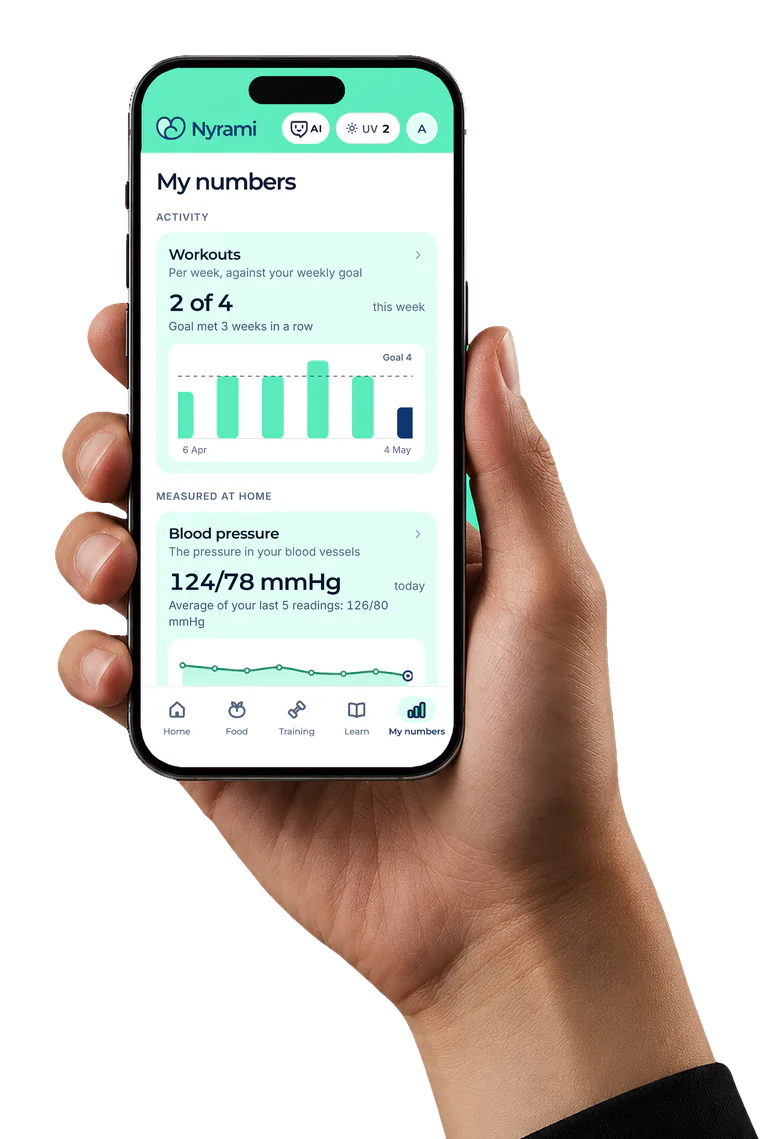
In the Nyrami app you keep your values together, such as eGFR, albumin and blood pressure, explained in words. That makes it easier to follow them over the years, whether you have a diagnosis yourself or are at risk because kidney disease runs in your family. The app is free for iPhone and Android.
Turns the advice into something you can use in the shop and the kitchen: scan food and see potassium, phosphorus and salt assessed for you, and follow your numbers over time. Free on iPhone and Android.