Chronic kidney disease (CKD) is divided into five stages by eGFR, from G1 (normal filtration, but signs of damage) to G5 (kidney failure, eGFR below 15). Stage 3 is split into 3a and 3b. You also get an albumin category from A1 to A3, and together they show how high your risk is.
Your test result or medical record may say something like “CKD G3a A2”. It is a code that says how well your kidneys filter, and how much albumin leaks into your urine. Here we explain what the letters and numbers mean, and what they mean for you. To read about the disease itself, its causes and treatment, see Chronic kidney disease.
How many stages of kidney disease are there?
Chronic kidney disease has five stages, G1 to G5, and stage 3 is split into 3a and 3b. The stage is set by eGFR, which shows how much blood the kidneys clean per minute. The classification comes from the international KDIGO guideline and is used by Norwegian doctors. “Grade” and “stage” mean the same thing.
eGFR (estimated glomerular filtration rate) is calculated from creatinine in the blood, age and sex. If you have a creatinine result, you can work out your eGFR in the calculator. The stage is only set once the value has been at that level for at least three months, because a single test can vary. Read more about the numbers in eGFR: normal range and Creatinine: normal range.
Stages by eGFR (G1 to G5)
G1
eGFR
90 or higher
Description
Normal or high
What it often means
The kidneys filter normally, but there are signs of damage, such as albumin in the urine
G2
eGFR
60 to 89
Description
Mildly reduced
What it often means
Usually no symptoms
G3a
eGFR
45 to 59
Description
Mildly to moderately reduced
What it often means
Often no symptoms, regular follow up with your GP
G3b
eGFR
30 to 44
Description
Moderately to severely reduced
What it often means
Tiredness and anaemia become more common
G4
eGFR
15 to 29
Description
Severely reduced
What it often means
Symptoms are common, often follow up with a kidney specialist
G5
eGFR
Below 15
Description
Kidney failure
What it often means
Dialysis, transplant or treatment without dialysis is considered
Stages by eGFR (G1 to G5)
Stage
eGFR
Description
What it often means
G1
90 or higher
Normal or high
The kidneys filter normally, but there are signs of damage, such as albumin in the urine
G2
60 to 89
Mildly reduced
Usually no symptoms
G3a
45 to 59
Mildly to moderately reduced
Often no symptoms, regular follow up with your GP
G3b
30 to 44
Moderately to severely reduced
Tiredness and anaemia become more common
G4
15 to 29
Severely reduced
Symptoms are common, often follow up with a kidney specialist
G5
Below 15
Kidney failure
Dialysis, transplant or treatment without dialysis is considered
eGFR in ml/min/1.73 m². G1 and G2 only count as chronic kidney disease when there are also signs of kidney damage. Source: KDIGO 2024, Norsk helseinformatikk.
What do A1, A2 and A3 mean?
A1, A2 and A3 show how much albumin leaks into the urine, measured as the albumin to creatinine ratio (uACR, called u-AKR in Norway). A1 is below 3 mg/mmol, A2 is 3 to 30 mg/mmol and A3 is above 30 mg/mmol. The more albumin, the higher the risk that the kidney disease will progress, and the risk of cardiovascular disease.
Albumin is a protein that healthy kidneys hold back. Albumin in the urine is often the very first sign of kidney damage, long before eGFR falls. That is why you can have chronic kidney disease even with a normal eGFR. Read more in Protein in urine.
Albumin categories (A1 to A3)
A1
uACR
Below 3 mg/mmol
Description
Normal to mildly increased
A2
uACR
3 to 30 mg/mmol
Description
Moderately increased
A3
uACR
Above 30 mg/mmol
Description
Severely increased
Albumin categories (A1 to A3)
Category
uACR
Description
A1
Below 3 mg/mmol
Normal to mildly increased
A2
3 to 30 mg/mmol
Moderately increased
A3
Above 30 mg/mmol
Severely increased
Some countries use mg/g: 3 and 30 mg/mmol correspond to 30 and 300 mg/g. Source: KDIGO 2024.
How do you read the risk chart?
The risk chart combines stage and albumin category. Green means low risk, yellow moderately increased, orange high and red very high risk. Two people with the same eGFR can therefore have very different risks: the one with a lot of albumin in the urine needs closer follow up and often more treatment.
Risk by stage and albumin (KDIGO)
G1
A1
Low (green)
A2
Moderate (yellow)
A3
High (orange)
G2
A1
Low (green)
A2
Moderate (yellow)
A3
High (orange)
G3a
A1
Moderate (yellow)
A2
High (orange)
A3
Very high (red)
G3b
A1
High (orange)
A2
Very high (red)
A3
Very high (red)
G4
A1
Very high (red)
A2
Very high (red)
A3
Very high (red)
G5
A1
Very high (red)
A2
Very high (red)
A3
Very high (red)
Risk by stage and albumin (KDIGO)
Stage
A1
A2
A3
G1
Low (green)
Moderate (yellow)
High (orange)
G2
Low (green)
Moderate (yellow)
High (orange)
G3a
Moderate (yellow)
High (orange)
Very high (red)
G3b
High (orange)
Very high (red)
Very high (red)
G4
Very high (red)
Very high (red)
Very high (red)
G5
Very high (red)
Very high (red)
Very high (red)
Risk that the kidney disease gets worse and of cardiovascular disease. Green in G1 and G2 without other signs of kidney damage is not chronic kidney disease. Source: KDIGO 2024.
When is kidney failure serious?
Kidney disease is considered serious when eGFR is below 30 (stages 4 and 5), when a lot of albumin leaks into the urine (A3), or when eGFR falls quickly from year to year. A kidney specialist should then be part of your follow up, and in time the conversation about dialysis, a new kidney or treatment without dialysis begins.
The Norwegian guideline for GPs says that your GP should contact a kidney specialist in stage 5, and in stage 4 with a lot of albumin in the urine. Contact with a kidney specialist is also considered in stage 4 otherwise, in stage 3b, with a lot of albumin (A3) whatever the eGFR, and with blood in the urine when the doctor suspects inflammation of the kidney filters. The international KDIGO guideline adds that a sustained fall in eGFR of more than 20 per cent should be looked into.
What does chronic kidney disease stage 3 mean?
Stage 3 means eGFR is between 30 and 59, which is moderately reduced kidney function. Many people in stage 3 have no symptoms and live as before, and some stay stable for many years with good treatment.
Stage 3a (eGFR 45 to 59) and 3b (eGFR 30 to 44) are separated because the risk rises noticeably in 3b. In stage 3 most people are followed by their GP (fastlege) with blood and urine tests, blood pressure checks and often kidney protecting medicines. Some eventually get high potassium or phosphate and need dietary advice tailored to their blood tests. See Food with kidney failure.
Stage 2 (eGFR 60 to 89) is only chronic kidney disease if there are also signs of damage, most often albumin in the urine. Without such signs, an eGFR in this range is common, especially in older people. How the tests are taken is explained in How to detect kidney disease.
What are the symptoms of stage 4 kidney disease?
In stage 4 (eGFR 15 to 29) kidney function is severely reduced, and many people get symptoms such as tiredness, poor appetite, nausea, itching, restless legs and difficulty sleeping. Anaemia and disturbances in potassium, phosphate and acid in the blood become more common and are treated with medicines and diet.
In stage 4 your GP should contact a kidney specialist or consider doing so, and many people are then followed by a kidney specialist. This is also when the conversation starts about what will happen if the kidneys fail: dialysis, transplant or treatment without dialysis. Feel free to bring a family member to these conversations, see Supporting someone with kidney disease. Read more about the signs in Symptoms of kidney failure.
What happens in stage 5?
Stage 5 means kidney failure: eGFR is below 15, and the kidneys can no longer keep the blood clean on their own. When the symptoms can no longer be kept in check with medicines, dialysis or a new kidney is needed. For some, especially the oldest and frailest, treatment without dialysis can be the best choice.
The choice is made together with your kidney specialist and depends on age, health and what you want yourself. Read more in Dialysis, Kidney transplant and End-stage kidney failure, which covers treatment without dialysis and the last phase.
How long can you live with stage 3, 4 and 5?
There is no single figure. Many people in stage 3 never need dialysis, and the risk depends mostly on how much albumin leaks and how fast eGFR falls. Your doctor can calculate your own risk of kidney failure over the next two and five years with a calculation called the KFRE (Kidney Failure Risk Equation).
In stages 4 and 5 the outlook also depends on age, the heart and which treatment you receive. Figures and explanations are in Kidney failure and life expectancy.
Can you go back to a lower stage?
Kidney tissue that has been lost does not come back, but eGFR varies from test to test. Dehydration, acute illness and some medicines, such as anti-inflammatory painkillers, can give a temporarily lower value that improves again. That is why the tests are repeated before the stage is set.
When you start certain kidney protecting medicines, eGFR can fall a little in the first weeks. This is expected and is a sign that the pressure in the kidney filters is going down. Albumin in the urine can often be reduced with treatment, and then you move down an A category. The aim of treatment is for eGFR to fall as slowly as possible. Read about painkillers and the kidneys.
How Nyrami can help
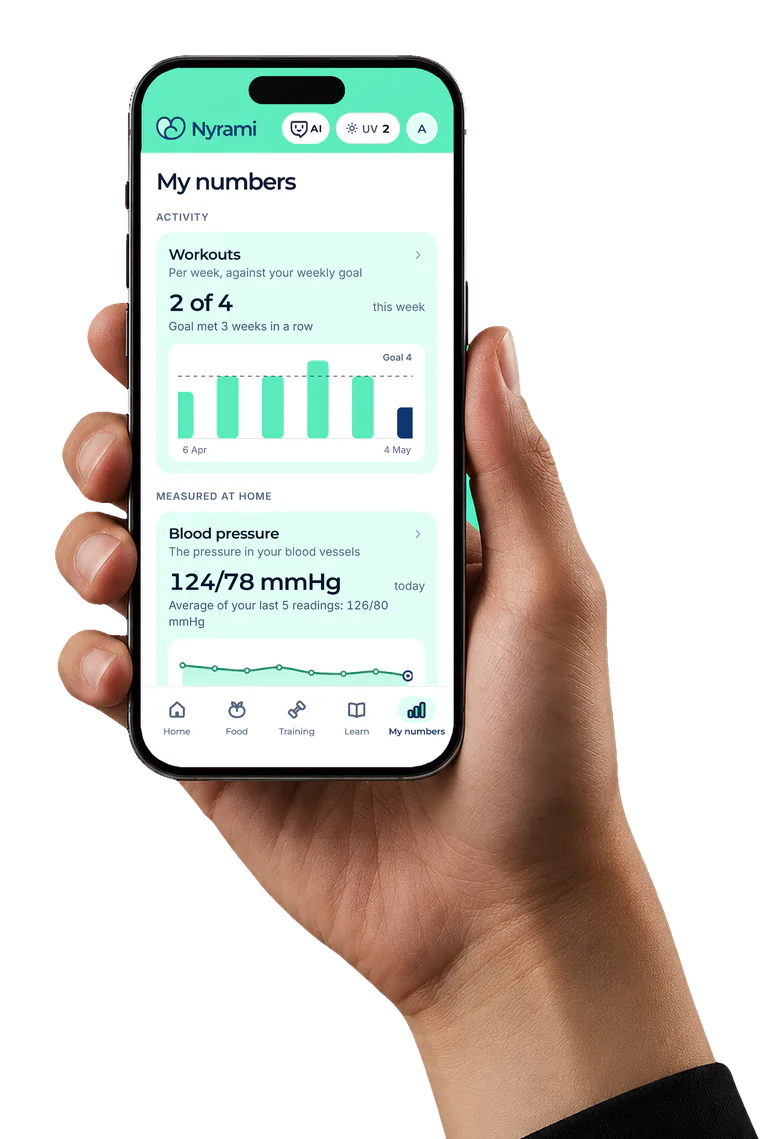
In the Nyrami app you enter your stage, eGFR and albumin, and get your values explained in words. You can see how they change over time, and the food scanner assesses potassium, phosphorus, sodium and protein in what you buy. The app is free for iPhone and Android.
Turns the advice into something you can use in the shop and the kitchen: scan food and see potassium, phosphorus and salt assessed for you, and follow your numbers over time. Free on iPhone and Android.