IgA nephropathy, also called IgA nephritis or Berger disease, is a chronic inflammation of the tiny filters in the kidneys. It most often affects young adults and typically causes blood in the urine a couple of days after a cold. The course varies a lot: many stay stable for decades, but some develop kidney failure. Treatment can slow it down.
Perhaps you noticed reddish brown urine after a sore throat, or were told there was blood and protein in a urine sample. Perhaps you have just had a kidney biopsy and got the answer IgA nephropathy. Here you will learn what the disease is, how it differs from other kinds of kidney inflammation, how it is treated, and what the numbers say about the future.
What is IgA nephropathy (IgA nephritis)?
IgA nephropathy is a chronic inflammation of the kidney filters, the glomeruli. It happens when an altered form of the antibody immunoglobulin A (IgA) forms clumps with other antibodies and gets stuck in the kidneys. There it causes inflammation and gradual damage. It is not an infection, and it is not contagious. IgA nephritis, IgA glomerulonephritis and Berger disease are other names for the same condition.
It is the most common form of primary glomerulonephritis in the world, and a frequent cause of severe kidney failure in young adults. It usually starts in young adulthood, affects men more often than women, and can also affect children. In Europe, 20 to 30 per million people develop it each year, according to Store medisinske leksikon (the Norwegian medical encyclopaedia). It is far more common in East Asia.
What is glomerulonephritis, and where does IgA nephropathy fit in?
Glomerulonephritis is an umbrella term for inflammation of the kidney filters caused by a fault in the immune system, not directly by bacteria or viruses. Typical findings are blood and protein in the urine, often with high blood pressure. IgA nephropathy is one of many such diseases, and the most common chronic form.
IgA nephropathy: chronic, variable course, blood in the urine shortly after infections.
Post-infectious glomerulonephritis: an acute inflammation that comes one to two weeks after an infection, classically after a strep throat or skin infection. It most often affects children, can cause dark urine, swelling and high blood pressure, and almost always settles on its own within a few weeks.
Other forms: for example membranous nephropathy, lupus nephritis and ANCA associated glomerulonephritis. They have their own causes and their own treatment.
Diseases of the kidney filters were behind eighteen per cent of those registered with stage 5 kidney failure in the Norwegian Renal Registry in 2024, before dialysis or transplantation. More about kidney disease in general is in Chronic kidney disease.
What are the symptoms of IgA nephropathy?
Many people with IgA nephropathy notice nothing for a long time, and the disease is found by chance when a urine test shows blood or protein. The most typical sign is visible blood in the urine, red, brown or cola coloured, that appears during or just after a cold or sore throat and then clears again.
Blood in the urine, visible or only found on a urine test
Swelling in the legs, ankles or around the eyes when protein leakage is large
Tiredness and other signs of reduced kidney function, usually late in the course
How protein in urine is measured, and what the numbers mean, is explained in Protein in urine.
Why does blood appear in the urine after an infection?
In IgA nephropathy, throat and airway infections switch on the immune system, and this can flare up the inflammation in the kidneys. The blood in the urine then appears quickly, often one to two days after the infection started. In post-infectious glomerulonephritis it takes longer, usually one to two weeks. The timing helps the doctor tell them apart, but only tests can settle it.
IgA nephropathy and post-infectious glomerulonephritis
When does blood appear in the urine?
IgA nephropathy
One to two days after the infection started
Post-infectious glomerulonephritis
One to two weeks after the infection
Who gets it?
IgA nephropathy
Mostly young adults, more men than women
Post-infectious glomerulonephritis
Mostly children
Course
IgA nephropathy
Chronic, can flare up again with new infections
Post-infectious glomerulonephritis
Acute, almost always settles within a few weeks
Diagnosis
IgA nephropathy
Kidney biopsy
Post-infectious glomerulonephritis
Usually from the history, urine and blood tests
IgA nephropathy and post-infectious glomerulonephritis
IgA nephropathy
Post-infectious glomerulonephritis
When does blood appear in the urine?
One to two days after the infection started
One to two weeks after the infection
Who gets it?
Mostly young adults, more men than women
Mostly children
Course
Chronic, can flare up again with new infections
Acute, almost always settles within a few weeks
Diagnosis
Kidney biopsy
Usually from the history, urine and blood tests
Source: NHI.no, Store medisinske leksikon, Tidsskrift for Den norske legeforening.
Is IgA nephropathy hereditary?
IgA nephropathy is not inherited in a simple way, as polycystic kidney disease is, for example. Inherited traits make some people more susceptible, but something must also trigger the disease. Most people who get it have no one in the family with the same diagnosis. If you have a close relative with IgA nephropathy, your risk is still somewhat higher.
There is no genetic test for IgA nephropathy. If someone in your family has it, a urine test and a blood pressure check with your GP (fastlege) is a simple way to check yourself. More about inherited kidney diseases is in Is kidney disease hereditary?.
How is IgA nephropathy diagnosed?
IgA nephropathy can only be confirmed with a kidney biopsy, a small tissue sample taken from the kidney with a thin needle. Under the microscope, the pathologist sees IgA deposits in the kidney filters. No blood or urine test can make the diagnosis on its own.
Investigation often starts with your GP. If blood in the urine persists, or protein in the urine is newly found, you should be referred to a kidney specialist (nephrologist), who decides whether you need a biopsy. The international KDIGO guideline (2025) recommends considering a biopsy in all adults with suspected IgA nephropathy and urine protein of 0.5 grams a day or more. The biopsy result gets a so called MEST-C score, which together with eGFR, blood pressure and urine protein says something about the risk ahead.
How is IgA nephropathy treated?
Treatment has two aims: to calm the inflammation that damages the kidneys, and to protect the kidney function that is left. The foundation is a blood pressure medicine of the ACE inhibitor or angiotensin II receptor blocker (ARB) type, which also reduces protein leakage, often together with an SGLT2 inhibitor. Which medicines suit you is decided by your kidney specialist together with you.
Blood pressure: KDIGO 2025 recommends a lower blood pressure target than usual, around 120/70 when tolerated. Read more in Blood pressure and the kidneys.
Protein in the urine: the goal is below 0.5 grams a day, ideally below 0.3 grams. Protein leakage is the best measure of whether treatment is working.
Lifestyle: stopping smoking, including snus and vaping, weight control, regular physical activity and little salt. KDIGO recommends less than 2 grams of sodium a day, which is about 5 grams of salt. See Salt and the kidneys.
Calming the immune system: at high risk, the kidney specialist may consider steroids (glucocorticoids) for a period. They can reduce protein leakage but cause side effects, and Norwegian nephrologists have traditionally been cautious.
Several new medicines have arrived in recent years. Targeted release budesonide (Kinpeygo), released in the gut, reduces production of the altered IgA, and sparsentan (Filspari) works both as a blood pressure medicine and by blocking the hormone endothelin. Both are approved in Europe. In Norway, Nye metoder (the Norwegian system for new treatments) decided in 2025 that Kinpeygo will not be introduced in public hospitals, because the price was too high for the documented benefit. Sparsentan was not taken into use in 2025, but is now being assessed again, and the price has not yet been settled. Several other medicines are being tested in trials. Ask your kidney specialist what is relevant for you, and whether you can take part in a study.
If you are planning a pregnancy, talk to your kidney specialist well in advance. Some of the medicines must not be used in pregnancy, and a Norwegian study found pre-eclampsia in many women with IgA nephropathy, even when the disease was thought to be mild.
What is the outlook for IgA nephropathy?
The course of IgA nephropathy varies a great deal. Some recover, many stay stable for decades, and some gradually lose kidney function. Norwegian figures show that around thirty per cent reach severe kidney failure needing dialysis or a transplant within 20 years. That also means most people do not within that time.
What matters most for the outlook is how much protein leaks into the urine over time, blood pressure, eGFR at diagnosis, and what the biopsy shows. Newer research shows that even fairly small amounts of protein in the urine over many years carry risk, which is why treatment goals have become stricter. Your doctor can use an international calculator (International IgAN Prediction Tool) to estimate your risk.
The figures describe groups, not you. They are based on patients followed before the newest medicines arrived. Read more in Can kidney failure get better?.
When should you see a doctor?
Contact your GP if you see blood in your urine, even if it clears by itself, or if your urine stays foamy, your legs swell or your blood pressure is high. If you already have IgA nephropathy, tell your doctor about new episodes of visible blood in the urine.
Call the out of hours service (legevakt) on 116 117 if you pass very little urine, have a lot of swelling or feel clearly weak and sick.
Call 113 for chest pain, severe breathlessness or if you feel close to fainting.
How Nyrami can help
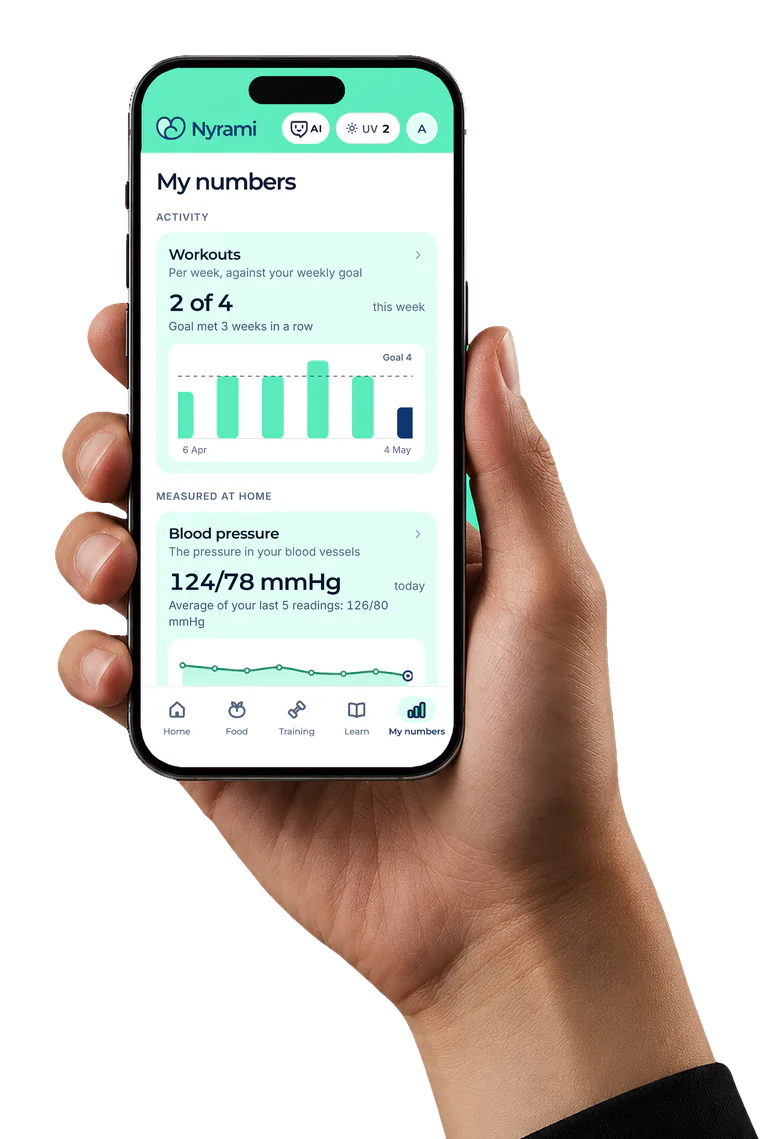
With IgA nephropathy, it is the numbers over time that count. In the Nyrami app you can keep your values, such as eGFR, albumin and blood pressure, in one place and see them explained in words. The food scanner assesses sodium and more for you, and the recipes are assessed per portion. The app is free for iPhone and Android.
Turns the advice into something you can use in the shop and the kitchen: scan food and see potassium, phosphorus and salt assessed for you, and follow your numbers over time. Free on iPhone and Android.