Chronic kidney disease (CKD) means the kidneys have been damaged or have worked less well than normal for at least three months. Around ten per cent of adults have it, most of them mildly and without noticing anything. The disease does not go away, but treatment can slow it down, often for many years.
Perhaps you have just been told that your eGFR is low, or that there is albumin in your urine. Or perhaps someone you love has been diagnosed. It is common to feel worried about that. Here you get the full overview: what the disease is, why it happens, how it is measured and what helps. Each part links on to a separate guide when you want to know more.
What is chronic kidney disease?
Chronic kidney disease is lasting damage to the kidneys that means they clean the blood less well than before. The doctor makes the diagnosis when eGFR is below 60, when too much albumin leaks into the urine, or when there are other signs of kidney damage, such as blood in the urine or findings on ultrasound, and the changes have lasted at least three months. The disease can range from very mild to severe.
The kidneys filter around 180 litres of fluid from the blood a day and make about two litres of urine. They control fluid and salts in the body, help regulate blood pressure and make hormones needed to form red blood cells and keep the bones strong. When the kidneys fail, it is therefore felt in several places in the body.
eGFR (estimated glomerular filtration rate) shows how much blood the kidneys clean per minute. The number is calculated from creatinine in the blood, age and sex. Albumin is a protein that healthy kidneys hold back. If it leaks into the urine, it is often the first sign of kidney damage. Read more in eGFR: normal range and what the number means and Protein in urine.
Helsedirektoratet (the Norwegian Directorate of Health) estimates that nine to eleven per cent of adults in Norway have chronic kidney disease, so around ten per cent, and at least two in three of them do not know. The vast majority have a mild form.
What is the difference between kidney disease and kidney failure?
Kidney disease is a general term for damage to the kidneys. Kidney failure means the kidneys can no longer clean the blood well enough: either suddenly, as acute kidney injury, or gradually, as stage 5 chronic kidney disease with an eGFR below 15. In everyday speech, kidney failure is often used about any reduced kidney function.
Acute kidney injury comes on over hours or days, for example with a serious infection, dehydration or certain medicines, and often gets better with treatment. Chronic kidney disease develops over months and years and usually does not go away. How the two show themselves is described in Symptoms of kidney failure.
What causes kidney disease?
The two most common causes of chronic kidney disease are high blood pressure and diabetes. Over time they damage the small blood vessels and filters in the kidneys. Other causes are inflammation of the kidney filters (glomerulonephritis), inherited diseases such as polycystic kidney disease, autoimmune diseases, congenital malformations and blockages in the urinary tract.
Among the almost 400 people registered with stage 5 kidney failure in the Norwegian Renal Registry (Norsk nyreregister) in 2024, before any start of dialysis or a new kidney, high blood pressure or disease of the kidney blood vessels was the cause in thirty-five per cent, diabetes in twenty-one per cent and disease of the kidney filters in eighteen per cent. High blood pressure and diabetes were therefore behind more than half. Of those who started dialysis or received a new kidney that year, more than a third had diabetes.
In the early stages, chronic kidney disease usually causes no symptoms. The kidneys can lose much of their function before you notice anything, and many people are diagnosed after a blood or urine test taken for another reason. Symptoms tend to appear gradually in stage 3 and become clearer in stages 4 and 5.
Tiredness and lack of energy
Swollen legs and ankles, or puffiness around the eyes
Itching and dry skin
Poor appetite, nausea and weight loss
Foamy urine or blood in the urine, or needing to pass urine more often at night
Muscle cramps, restless legs and poor sleep
None of these signs is specific to the kidneys. That is why the tests say more than the symptoms. Read more in Symptoms of kidney failure.
Which tests show kidney disease?
Two simple tests reveal chronic kidney disease: a blood test that measures creatinine and gives you an eGFR, and a urine test that measures the ratio between albumin and creatinine (uACR, called u-AKR in Norway). If eGFR is below 60 for more than three months, or uACR is 3 mg/mmol or higher in at least two of three tests taken within three months, you have chronic kidney disease.
A single test is not enough. Dehydration, acute illness and some medicines can give a temporarily worse value, which is why the tests are repeated. If you have high blood pressure, diabetes or cardiovascular disease, your GP (fastlege) should take both tests regularly. Sometimes an ultrasound of the kidneys is also done, and in some cases a tissue sample (biopsy).
Chronic kidney disease is divided into five stages by eGFR, from G1 (normal filtration, but signs of damage) to G5 (kidney failure, eGFR below 15). You also get an albumin category from A1 to A3. Together they show how high the risk is that the disease will progress, and the risk of cardiovascular disease.
Stages of chronic kidney disease by eGFR
G1
eGFR
90 or higher
What it means
Normal filtration, but signs of damage, such as albumin in the urine
G2
eGFR
60 to 89
What it means
Mildly reduced
G3a
eGFR
45 to 59
What it means
Mildly to moderately reduced
G3b
eGFR
30 to 44
What it means
Moderately to severely reduced
G4
eGFR
15 to 29
What it means
Severely reduced
G5
eGFR
Below 15
What it means
Kidney failure
Stages of chronic kidney disease by eGFR
Stage
eGFR
What it means
G1
90 or higher
Normal filtration, but signs of damage, such as albumin in the urine
G2
60 to 89
Mildly reduced
G3a
45 to 59
Mildly to moderately reduced
G3b
30 to 44
Moderately to severely reduced
G4
15 to 29
Severely reduced
G5
Below 15
Kidney failure
eGFR in ml/min/1.73 m². Source: KDIGO 2024, Norsk helseinformatikk.
The full explanation, with the albumin categories, the risk chart and what each stage means, is in Kidney failure stages.
How is chronic kidney disease treated?
No treatment cures chronic kidney disease, but treatment can slow it down, delay the need for dialysis and protect the heart. The foundation is treating the cause: well controlled blood pressure and blood sugar, stopping smoking, physical activity, weight control and a diet low in salt.
Norwegian kidney specialists recommend keeping blood pressure below 130/80 for most people. Several medicines protect the kidneys, including blood pressure medicines of the ACE inhibitor or ARB type, and SGLT2 inhibitors. Many people also get cholesterol lowering medicine to protect the heart. Which ones suit you is decided by your doctor together with you. Read more in Medicines in kidney disease.
If the kidneys fail (stage 5), dialysis or a new kidney is needed, or treatment without dialysis for some of the oldest. At the end of 2024, 5,517 people in Norway were on dialysis or living with a transplanted kidney, according to the Norwegian Renal Registry: 1,836 on dialysis and 3,681 with a working transplanted kidney. Read more in Dialysis, Kidney transplant and Life on dialysis.
What should you eat with chronic kidney disease?
Most people with chronic kidney disease benefit most from little salt, enough protein without overdoing it, and otherwise ordinary healthy food. You only need to limit potassium and phosphorus if your blood tests show the levels are too high, and your doctor or dietitian decides that together with you.
What does chronic kidney disease mean in older people?
Kidney function falls with age, and chronic kidney disease becomes more common the older we get. According to an article in Indremedisineren, the journal of the Norwegian Society of Internal Medicine, just under one in five people aged 65 to 74 have chronic kidney disease, and more than half of those over 85. In the oldest, though, the disease more often progresses slowly, and only a few develop kidney failure.
For older people, the most important thing is to avoid what strains the kidneys: anti-inflammatory painkillers, dehydration during illness and medicines in too high a dose. Medicines should be dosed by kidney function, not just by creatinine. Read more in Kidney failure in older people.
Is chronic kidney disease dangerous?
Chronic kidney disease can become serious, but many people never need dialysis or a transplant, and many live well with the disease for many years. The biggest danger is often the heart: cardiovascular disease is the most common cause of death in people with chronic kidney disease. That is why treatment is as much about the heart as about the kidneys.
As a family member or carer you can do a lot by being there, learning together with the person you love, and looking after yourself. You have a right to information about their health when they consent to it.
Go to appointments together if the person you love wants you to. Two pairs of ears remember more, and you can write down your questions beforehand.
Learn the values together. Ask to see the test results, and ask what eGFR and albumin mean and how they have changed.
Look after yourself. It is all right to get tired. Talk to someone, and ask for help before it gets too heavy.
Contact your GP (fastlege) if you have high blood pressure, diabetes or heart disease and have not had your kidneys checked for a while, or if you notice swelling in your legs, increasing tiredness or changes in your urine.
Call the out of hours service (legevakt) on 116 117 if you have severe nausea and vomiting, great weakness, shortness of breath or pass very little urine.
Call 113 if you have chest pain, serious breathing problems or feel as if you are about to faint.
Ask your doctor what to do with your medicines if you get vomiting, diarrhoea or a fever. For some blood pressure and diabetes medicines, a short pause is recommended during such periods, but you should agree this with your doctor in advance.
How Nyrami can help
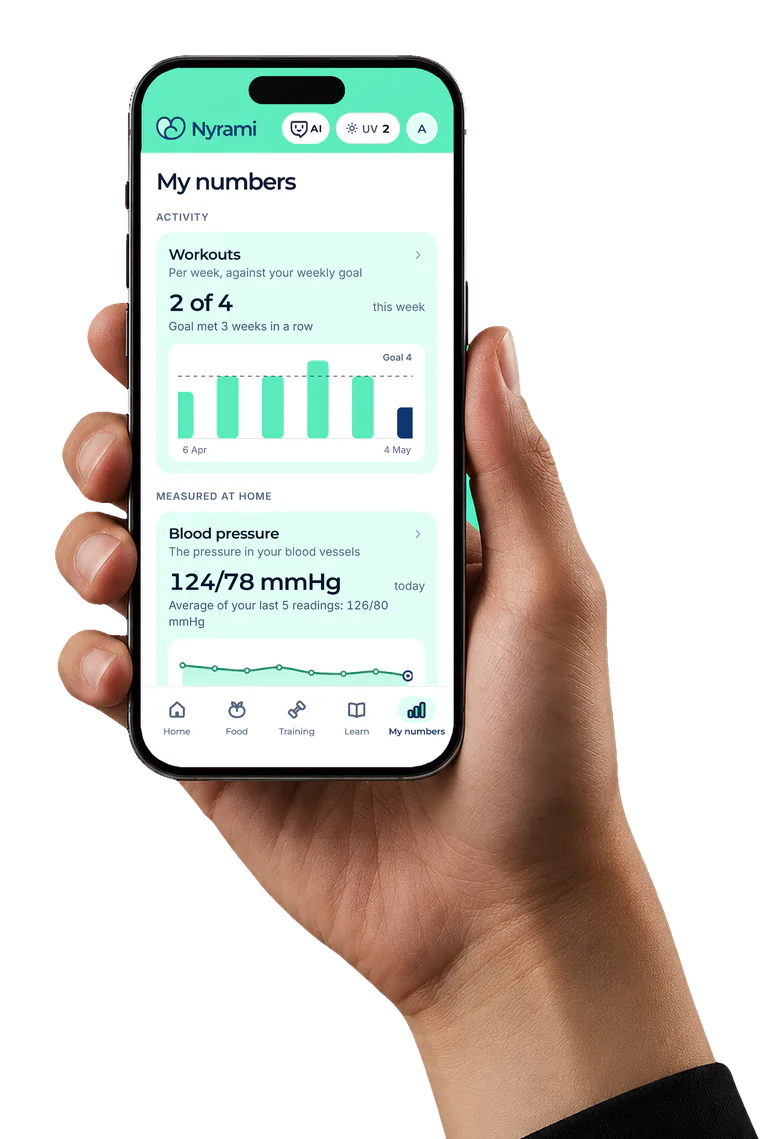
The Nyrami app gathers your values, such as stage, eGFR, creatinine, albumin and blood pressure, and explains what they mean. The food scanner reads the barcode and assesses potassium, phosphorus, sodium and protein for you, and you will find 148 recipes assessed per portion, workouts with video and Learn articles. The app is free for iPhone and Android.
Turns the advice into something you can use in the shop and the kitchen: scan food and see potassium, phosphorus and salt assessed for you, and follow your numbers over time. Free on iPhone and Android.