Cristian's story as a kidney patient became the start of something bigger
When Cristian Velasquez became seriously ill with kidney disease in his late twenties, life was turned upside down. Two kidney transplants and many years of dialysis later, his experience has helped shape Nyrami, a platform that gives people with kidney disease more knowledge and insight to take an active part in their own health.
For Cristian the story began in 2003, when he was diagnosed with glomerulonephritis and told that his kidneys were failing. The very next year the father of the family had to start life-sustaining dialysis, because his kidneys could no longer clean his blood well enough.
In haemodialysis the blood passes through a filter in a dialysis machine that removes waste products and excess fluid before the blood is returned to the body. The treatment replaces part of what the kidneys do, but it takes time and can be very hard on the body, with tiredness, drops in blood pressure and a need to recover after each session.
After almost three unbroken years of five-hour dialysis sessions three to four times a week, Cristian received a new kidney in 2006 and could finally put dialysis behind him.
Five hours at a time, three to four times a week.
But nine years later the transplanted kidney failed. In 2015 Cristian had to go back on dialysis. This time it would be six years of the time-consuming and exhausting treatment before he was given the chance of a new transplant.
Struck by cancer, twice
In a kidney transplant, the new kidney is usually put in without the patient's own kidneys being removed. When Cristian's first transplant stopped working and he had to go back on dialysis in 2015, the doctors found cancer in one of his own kidneys. The kidney was removed, and the cancer meant he had to come off the waiting list for a new transplant for two years.
Later, cancer was found in the other kidney too, and it also had to be removed. That meant two more years in which a new transplant had to wait. For Cristian, this shows how other illnesses and complications can affect the road to a new transplant.
The six unbroken years of dialysis and two rounds of cancer were a very hard time for Cristian and his family. On top of the kidney disease and the cancer, he was struck several times by sepsis (blood poisoning) from the surgical wound after one of the kidneys had been removed.
The seriousness of the situation made Cristian ever more focused on what he himself could do to keep both his physical and his mental strength. He trained at home to maintain his muscle mass, and used breathing exercises and meditation to handle stress and unease. Every morning he did balance exercises out on the terrace, whatever the season and the weather.
Nature became important too. With his youngest daughter, who was at nursery at the time, he walked down to the sea or into the forest. It gave him valuable breaks from a daily life marked by illness and treatment.
Together with a diet adapted to the disease, these routines became an important part of his everyday life. The experience made Cristian ever more aware of how much it matters to understand your own body and use that knowledge to make active choices, even when much about the disease was beyond his control.
Home-grown potatoes taught Cristian something important
Cooking was also an important part of everyday life. Cristian wanted to make good, healthy food for his family, and during the pandemic he began growing his own potatoes and vegetables.
Cristian with one of the potatoes he grew himself.
Working outdoors gave him both activity and a welcome break from the illness. Getting outside, using his body and quite literally getting his hands in the soil gave him energy and a sense of mastery. At the same time, Cristian grew curious about what he was growing: what did the different vegetables actually contain, and how did they affect his body as a kidney patient?
Potatoes became a good example of how complicated the relationship with food can be for a kidney patient. Potatoes are healthy food for healthy people, but because they contain a lot of potassium, they can be a problem for some people on dialysis.
To avoid a raised level of potassium in the blood, the simplest message could therefore have been: “Avoid potatoes.” But Cristian learned that the picture had more nuance. By understanding what food contains, keeping track of your own blood tests and learning how things like quantity and preparation affect what you take in, it can in some cases be possible to keep foods you value as part of your diet.
Soaking and boiling potatoes and certain other vegetables can, for example, reduce their potassium content. How much potassium each person can eat must still be adapted to their own illness, treatment and blood tests.
For Cristian, growing his own food therefore became more than a way to stay active. It gave him joy and energy in a demanding time, but it also woke a curiosity about the connection between the food he grew, the nutrients it contained and his own health. Knowing more made it possible to look for adjustments and possibilities rather than only limits.
That way of thinking would later become central to Nyrami.
Knowledge gives room to make good choices in everyday life
Living with serious kidney disease involves many choices that are made outside the hospital.
“What do I eat? How much do I drink? How much salt, potassium and phosphate am I getting? Am I getting enough protein and energy? What do my latest blood tests mean for what I should do right now?”
Nor are the answers necessarily the same through the whole course of the disease. The needs of a person with moderate kidney disease can be different from those of someone on dialysis. After a transplant the situation changes again.
What Cristian learned over the years was how important it is to understand why the advice changes. Because there is a great difference between being given a list of foods to limit, and understanding how food affects the body, what your own test results mean and which adjustments you can make.
Dialysis replaces important parts of what the kidneys do, but not everything healthy kidneys do continuously around the clock. Between treatments, fluid and waste products among other things can build up in the body. Diet and fluid intake therefore become an important part of the treatment for many dialysis patients.
At the same time, dialysis can be physically demanding. Good nutrition is not only about which substances to limit, but also about getting enough nourishment to keep up energy, muscle mass and the best possible physical function. That is why there is no single “kidney diet” that suits everyone.
Cristian's experience was that the more he understood about the disease and his own body, the better equipped he was to make good choices in everyday life.
From serious kidney disease to Nyrami
In 2021 Cristian had his second kidney transplant. The difference from the years on dialysis was great. He got back freedom, energy and a daily life no longer ruled by several treatments a week.
Summer 2021, the first holiday after his second transplant.
“My first boat trip in eight years. Without being tied to a dialysis machine, or having to stay close to a hospital.”
The transplant still requires medication and follow-up, and looking after his health through diet and physical activity is still an important part of his life. For Cristian it is about looking after the chance he has been given, both his own health and the transplanted kidney. At the same time, he wants to use his own experience to help others.
Cristian's illness has also marked his family. His sons Marcus and Andreas grew up with a dad who was seriously ill with kidney disease, and have seen at close hand how dialysis, transplants and life with kidney disease affect everyday life.
Today Marcus is founder and chair of the board, and Andreas is COO, of Tech Norway, the technology company that developed Nyrami. Cristian works as a senior adviser in the company, which promotes innovative Norwegian start-ups of value to society through technology and marketing.
Cristian with his sons Marcus and Andreas.
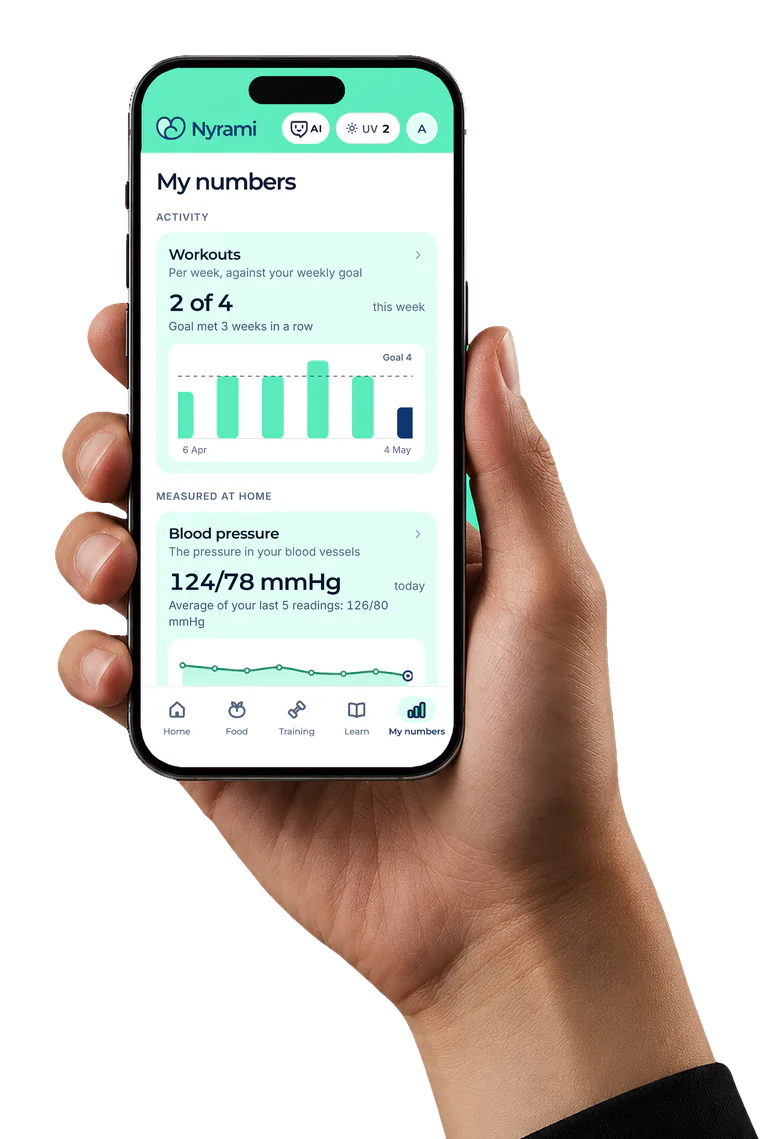
The family's experience of more than 20 years of kidney disease has helped to shape Nyrami, a platform to help people with kidney disease understand their own situation better and make it easier to make good choices in everyday life, alongside the treatment and the advice they get from healthcare professionals.
Nyrami builds on much of what Cristian himself has learned: It is easier to look after your own health when you understand it.
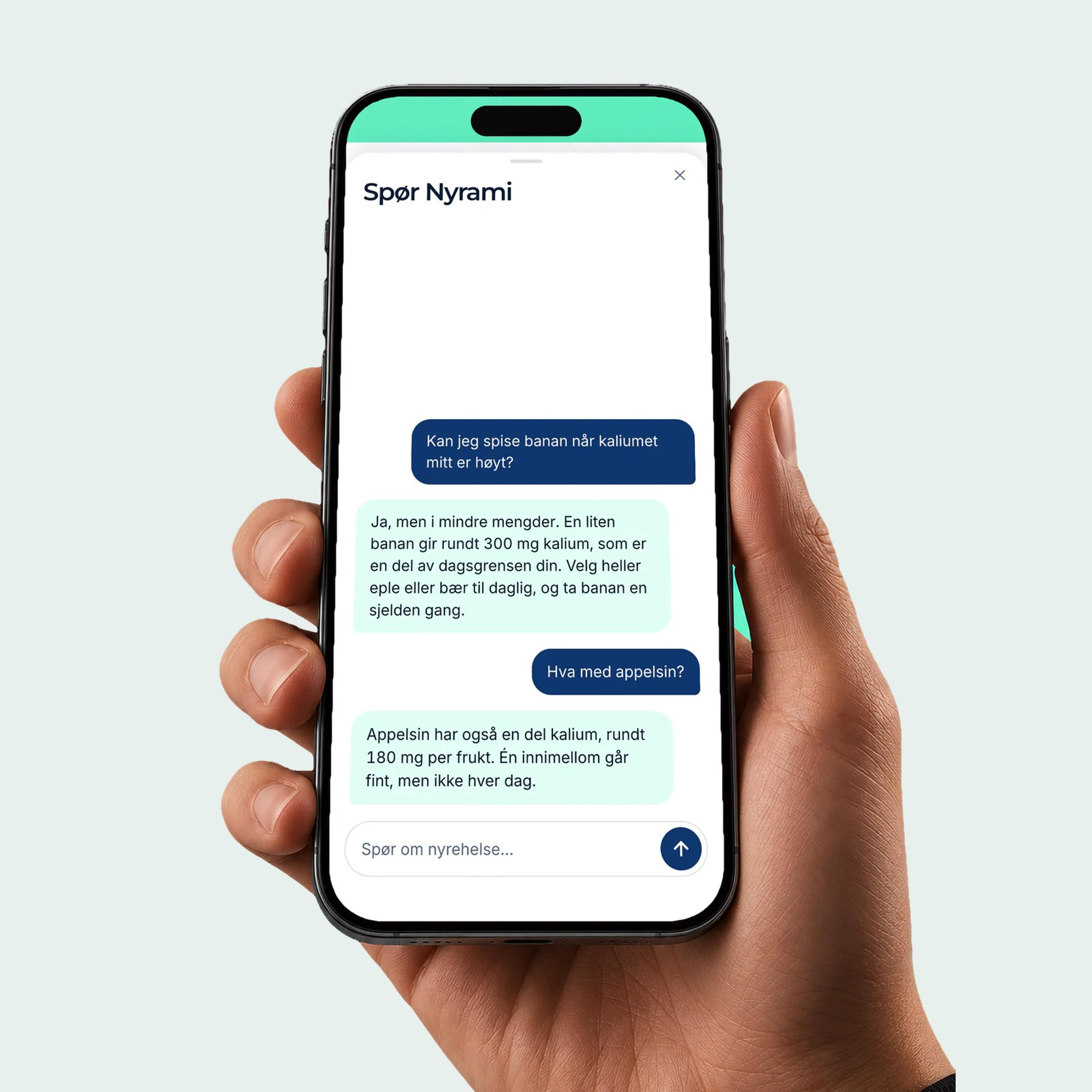
To know why a test result matters. To understand how food affects the body. To discover that a diet adapted to kidney disease need not only be about what is forbidden, but also about knowledge, adjustments and possibilities. Sometimes it can be as concrete as knowing how to prepare a potato.
In this way, what began with serious illness in one father has become something that can benefit far more people with kidney disease.
Turns the advice into something you can use in the shop and the kitchen: scan food and see potassium, phosphorus and salt assessed for you, and follow your numbers over time. Free on iPhone and Android.