Exercise with kidney disease or failure: how to get started
Yes, you can and should exercise with kidney disease. International guidelines recommend at least 150 minutes of moderate activity a week, adapted to what your body can manage. Both cardio and strength training help, also on dialysis and after a kidney transplant. Start gently and build up gradually.
Many people who get a kidney diagnosis are unsure whether they can cope with exercise. For the vast majority, the answer is yes. Physical activity is one of the few things you can do yourself every day that affects your heart, blood pressure, blood sugar and how you feel.
Can I exercise if I have kidney failure?
Yes. Most people with kidney disease and kidney failure can exercise and benefit from it, and with mildly reduced kidney function there are no special limits on how active you can be. Exercise counteracts high blood pressure, diabetes and excess weight, which are among the most important reasons kidney disease gets worse. The only thing NHI.no (the Norwegian health information site) warns against is starting abruptly with heavy strength training.
The Norwegian guideline for chronic kidney disease counts physical activity as one of the lifestyle measures your GP (fastlege) should help you start, together with stopping smoking, weight control and dietary advice. The reason is that heart and blood vessel disease is the biggest threat to health in chronic kidney disease, and that is where exercise works well.
What does the research say about exercise and kidney disease?
Research shows that exercise gives better fitness, stronger muscles and better quality of life in people with kidney disease, including those on dialysis. Whether exercise itself slows the loss of kidney function is less certain. Most of the benefit comes through blood pressure, blood sugar, weight and energy.
A large Cochrane review from 2022 pooled 89 studies with 4,291 dialysis patients. Exercise probably reduced depressive symptoms and improved function, measured as longer walking distance and stronger legs. It may also reduce fatigue. The effect was fairly similar for cardio, strength and a mix of both.
The researchers point out that few studies followed patients long enough to say anything about heart attacks and life expectancy. So exercise is no cure, but it is a good tool for coping better in everyday life.
How much should you exercise?
The guideline from KDIGO, the international expert group for kidney disease, recommends moderate activity for a total of at least 150 minutes a week, or as much as your heart and body can manage. That is the same as a brisk 20 to 25 minute walk every day. Also avoid sitting still for large parts of the day.
The advice from Helsedirektoratet (the Norwegian Directorate of Health) for all adults is 150 to 300 minutes of moderate activity a week, or 75 to 150 minutes at high intensity, plus exercises that strengthen large muscle groups at least two days a week. If you manage less, a little is better than nothing. Many people find it easier to get started when someone walks with them, so ask a friend or someone in the family.
Strength or endurance: which is best?
A mix is best. Endurance training such as walking, cycling and swimming strengthens the heart and blood vessels, while strength training builds and preserves muscle. In kidney disease, muscle breaks down more easily, and NHI.no writes that the combination gives better results and prevents muscle loss.
Endurance: walk briskly, cycle, swim or go cross-country skiing. You should be able to talk, but get a little out of breath.
Strength: sit-to-stand from a chair, calf raises, wall push ups, resistance bands or light dumbbells. Choose a weight you can lift slowly many times, not the heaviest possible.
Balance and mobility: especially useful if you are older or have fallen before.
Yes. Exercise during and between dialysis sessions has been studied for many years and improves fitness, strength and quality of life. Many people feel tired after dialysis, so it is a good idea to do your hardest session on a day without treatment, and keep it light straight after dialysis.
In the studies, exercise during dialysis is often done on a pedal bike fixed in front of the chair, or with resistance bands and ankle weights. It is usually done early in the session, because drops in blood pressure are more common towards the end. Ask your dialysis unit whether they have a programme, or whether you can be referred to a physiotherapist.
Ask what you can do with the arm that has your fistula or catheter.
If you are on peritoneal dialysis, ask about heavy lifting and abdominal exercises.
Remember that drinks during and after exercise count towards your fluid limit.
After the transplant you get out of bed as early as the next day, and a physiotherapist makes a programme for you. For the first 8 to 12 weeks you should avoid sit ups and other abdominal exercises, heavy lifting and sports with sudden movements. After that you can increase the load gradually.
LNT (the Norwegian association for kidney patients and transplant recipients) writes that a couple of shopping bags are fine during this period, but nothing much heavier. One rule lasts for life: LNT writes that kidney transplant recipients should avoid martial arts. The new kidney is placed low in the abdomen and is therefore more exposed than your own kidneys. Read more about kidney transplantation.
Exercise at different stages of kidney disease
Mildly reduced kidney function
What you can do
Exercise like other adults
What to watch out for
Increase strength training gradually
More reduced kidney function
What you can do
Walking, cycling, light strength training
What to watch out for
Adapt to how you feel that day and to your blood pressure
Haemodialysis
What you can do
Pedal bike and resistance bands during or between sessions
What to watch out for
Drops in blood pressure, fistula arm, fluid limit
Peritoneal dialysis
What you can do
Walking and light strength training
What to watch out for
Ask about abdominal exercises and heavy lifting
First 8 to 12 weeks after a transplant
What you can do
Walking and a programme from your physiotherapist
What to watch out for
No abdominal exercises, heavy lifting or sports with sudden movements
Long term after a transplant
What you can do
Most things, increasing gradually
What to watch out for
Never martial arts
Exercise at different stages of kidney disease
Situation
What you can do
What to watch out for
Mildly reduced kidney function
Exercise like other adults
Increase strength training gradually
More reduced kidney function
Walking, cycling, light strength training
Adapt to how you feel that day and to your blood pressure
Haemodialysis
Pedal bike and resistance bands during or between sessions
Drops in blood pressure, fistula arm, fluid limit
Peritoneal dialysis
Walking and light strength training
Ask about abdominal exercises and heavy lifting
First 8 to 12 weeks after a transplant
Walking and a programme from your physiotherapist
No abdominal exercises, heavy lifting or sports with sudden movements
Long term after a transplant
Most things, increasing gradually
Never martial arts
Sources: NHI.no, LNT, Cochrane 2022. Advice from your own care team comes first.
Can hard exercise damage the kidneys?
Ordinary exercise does not damage the kidneys. In rare cases, extremely hard exercise can cause rhabdomyolysis, where large amounts of muscle cells break down and the waste products put strain on the kidneys. It usually happens after an unfamiliar, exhausting session, often after a break, in the heat and without enough to drink.
The signs are severe muscle pain, swollen muscles and reddish brown urine that looks like tea or cola. NHI.no states that five to seven per cent of people who get rhabdomyolysis develop acute kidney failure. If you notice this after exercise, see a doctor the same day. It is also why you should increase your training a little at a time if you have kidney disease.
How long after exercise does rhabdomyolysis appear?
The signs often do not come during the session, but in the hours and days after. In a case NHI.no describes, pupils got muscle pain and dark urine within two to four days after an unusually hard PE lesson. Treatment with fluids works best early, within one to three days, so do not wait and see. Hard exercise and creatine supplements can also give a high creatinine on your blood test without kidney damage, see creatinine normal range.
When should you not exercise?
Skip your workout when your body needs rest or is short of fluid. This applies especially in these situations:
When you have a fever or an infection. NHI.no advises against all exercise as long as you have a fever.
Right after vomiting or diarrhoea, when your body can easily be short of fluid.
If you feel dizzy or have low blood pressure after dialysis.
If you have been told your potassium is high and you feel muscle weakness. Then you should contact a doctor, not exercise.
When should you be careful?
Be careful, and talk to your doctor before stepping up, if you have heart disease, dizziness, unstable blood pressure or have just started new medicines. After a period of illness, start gently again.
If you have polycystic kidney disease, avoid contact sports and sports with hard blows to the stomach and back. Read more in is kidney disease hereditary?
If you are at stage 4 or 5, plan your training together with your care team.
If you use insulin, exercise can cause low blood sugar. Keep something sweet at hand. See also diabetes and the kidneys.
Well controlled blood pressure makes exercise safer, and exercise in turn helps your blood pressure.
When should you contact a doctor?
Stop and contact a doctor if you get chest pain, shortness of breath that does not settle with rest, fainting or palpitations during exercise. Reddish brown urine and severe muscle pain after exercise also need a quick assessment. In Norway, call the out-of-hours service (legevakt) on 116 117, or 113 for chest pain and emergencies.
How Nyrami can help
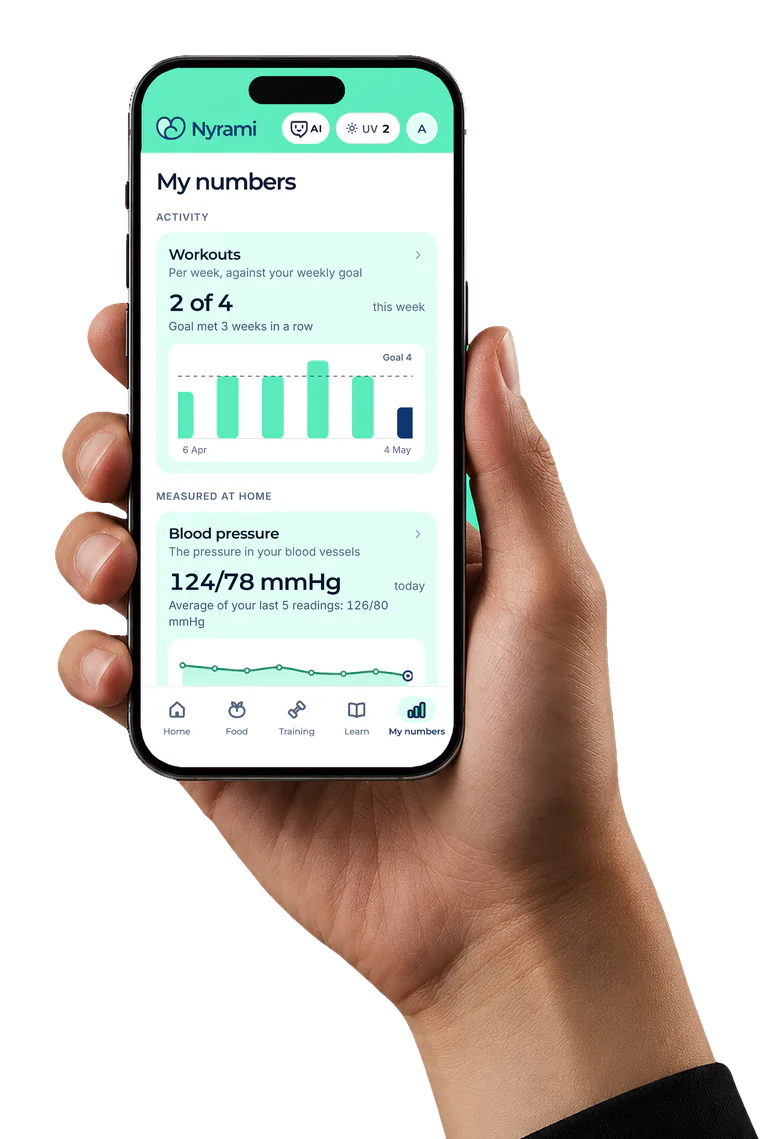
In the Nyrami app you will find video workouts you follow at your own pace, with both strength and cardio. Your values, such as blood pressure and weight, are there too, explained in words, so you can see the whole picture. The app is free for iPhone and Android.
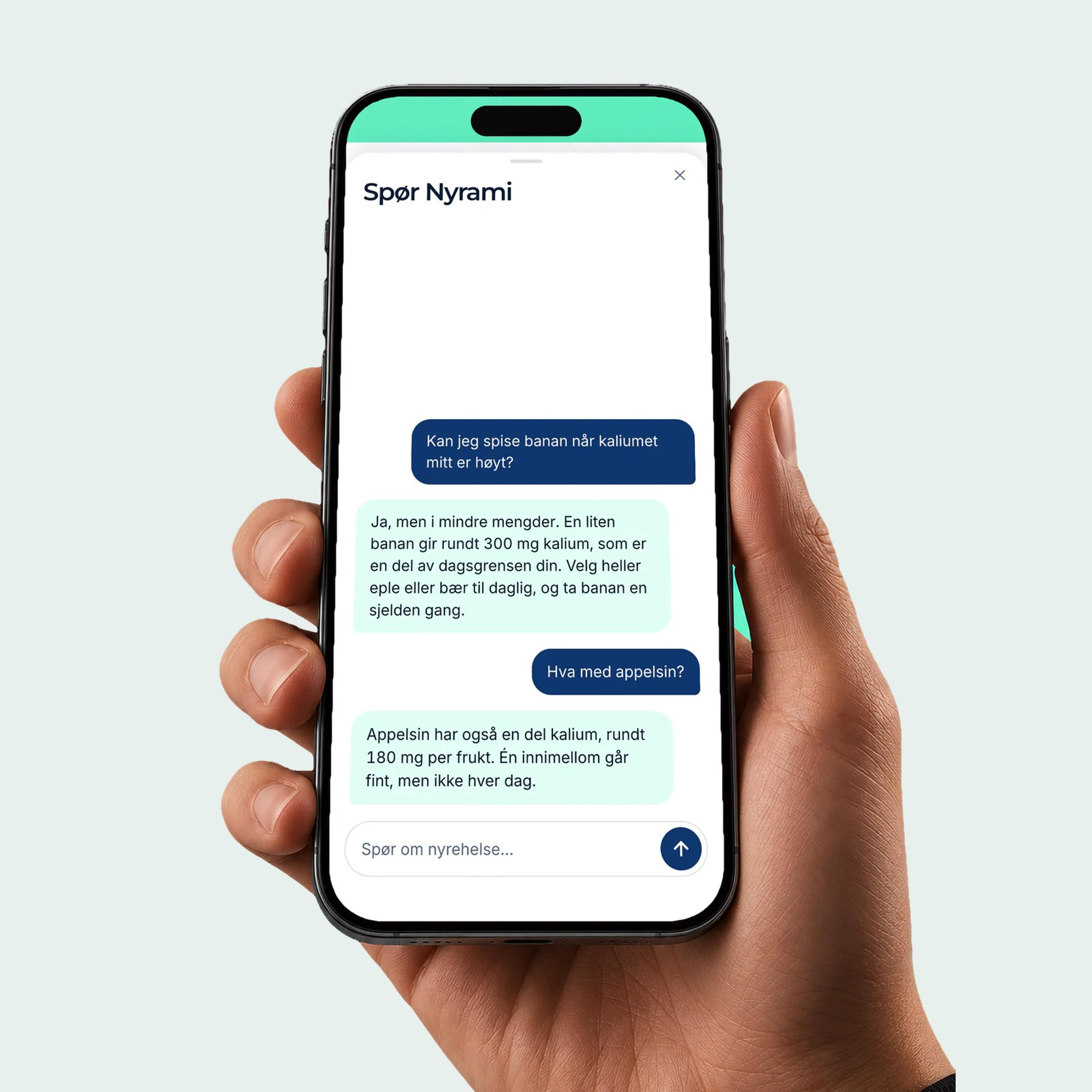
Turns the advice into something you can use in the shop and the kitchen: scan food and see potassium, phosphorus and salt assessed for you, and follow your numbers over time. Free on iPhone and Android.