Fluids in kidney disease: how much should you drink?
With good or moderate kidney function, drinking to thirst is enough, and more water than that does not protect the kidneys. When kidney function becomes very low, and especially on haemodialysis, many people get a fluid limit, often around 700 ml a day plus what they pass as urine. Your doctor sets your limit.
"Drink more water" is well meant, but it is not advice that suits everyone with kidney disease. How much you should drink depends on how much kidney function you have, whether you pass urine as before, and whether you are on dialysis. Both too little and too much can cause problems.
Is drinking lots of water good for the kidneys?
No, for most people with kidney disease drinking more than your thirst tells you gives no extra protection. In a Canadian study, 631 people with stage 3 chronic kidney disease were either coached to drink more water or told to drink as before. Those who drank more passed about 0.6 litres more urine a day, but kidney function fell by about the same amount in both groups after one year.
There are exceptions. In polycystic kidney disease, LNT recommends drinking plenty, more than 2 litres a day, because it may slow the growth of the cysts, although the evidence is not certain. To prevent kidney stones the advice is often around 2 to 2.5 litres a day, so that your urine is pale. If you have one of these conditions, follow the advice your doctor has given you. Read more in Is kidney disease hereditary?
How much should you drink with kidney disease?
With good or moderate kidney function, drinking to thirst is enough. Helsenorge says that older adults need about 1 to 1.5 litres of drinks a day on top of the fluid in food. You need more when it is hot, when you sweat a lot and when you exercise.
It is only when kidney function becomes very low, or when the body starts holding on to water, that your doctor sets a fluid limit. Do not restrict fluids on your own. Too little fluid can also harm the kidneys: if you become dehydrated from vomiting, diarrhoea or fever, kidney function can drop suddenly, especially if you take blood pressure medicine, water tablets or an SGLT2 inhibitor. Ask your doctor for a plan for days like that.
Fluids by situation
Situation
Usual advice
Good or moderate kidney function
Drink to thirst. More water does not protect the kidneys.
Polycystic kidney disease
Often more than 2 litres a day, as advised by your doctor.
Kidney stones
Often around 2 to 2.5 litres a day.
Advanced kidney failure with swelling
Your doctor may set a fluid limit.
Haemodialysis
Often around 700 ml a day plus what you pass as urine.
Peritoneal dialysis
Your doctor decides whether you need a limit.
After a kidney transplant
Follow the advice of the transplant team.
Source: Helsenorge, LNT, St. Olavs hospital. These are common starting points. Your own advice may be different.
Why does the body hold on to water in kidney failure?
When kidney function becomes low, the kidneys cannot get rid of all the salt and water you take in, and the excess stays in the body. At first it is often noticed as swollen ankles and calves, or swollen hands in the morning. A lot of salt makes it worse, because salt holds on to water and makes you thirsty.
Rapid weight gain is often the first sign, and it is easier to spot than swelling. One kilo is roughly one litre of fluid. Over time the fluid can collect in the lungs. That causes breathlessness, especially when you lie flat, and can raise blood pressure. Read more in Symptoms of kidney failure and The kidneys and the heart.
What is a fluid restriction, and how much can you drink on dialysis?
A fluid restriction means your doctor sets an upper limit for how much you should drink a day. It is given when the kidneys can no longer get rid of enough water, and is most common on haemodialysis, because many people then pass little or no urine.
St. Olavs hospital uses this as a starting point on haemodialysis: if you pass no urine, you should not drink more than 700 ml a day. If you still pass urine, you can drink 700 ml more than your urine volume, so with 400 ml of urine a day it becomes 1.1 litres. If you keep to the limit, you get fewer drops in blood pressure and leg cramps during dialysis and feel less worn out. On peritoneal dialysis your doctor decides whether you need a limit. Read more in Life on dialysis and Dialysis.
What counts as fluid, and what is best to drink?
Anything that is liquid at room temperature counts towards the fluid limit. Some of it is easy to forget:
Coffee, tea, milk, juice, fizzy drinks, beer and wine.
Soup, sauce and thin porridge.
Yoghurt, ice cream and jelly.
Juicy fruit and vegetables, which also contain a lot of water.
How can you manage the fluid limit and the thirst?
Use small glasses and cups. The same number of glasses feels the same, but adds up to less fluid.
Measure out the day's amount in a jug in the morning, so you can see what is left.
Eat less salt. It is the easiest way to feel less thirsty. See Salt and the kidneys.
Suck an ice cube, or rinse your mouth without swallowing.
Chew sugar free gum.
Spread your drinks through the day, and save a little for your medicines.
Write down what you drink, especially at first.
Why should you weigh yourself?
Your weight is the simplest way to keep track of fluid. Weigh yourself at the same time every morning, after using the toilet and before breakfast, in as few clothes as usual. A rule of thumb Helsenorge uses for heart failure is that more than two kilos in three to four days may mean too much water in the body. It is useful in kidney failure too. Tell your doctor if it happens.
On haemodialysis you are weighed before and after every session. The weight gained between sessions shows how much fluid needs to be removed, and the aim is to get down to your dry weight: the weight at which you have neither too much nor too little fluid in your body.
What can you do as a family member?
At home it is often the family who first notice swelling, breathlessness or weight going up. If you know the fluid limit, you can help with small glasses, ice cubes and less salt in the food, without becoming the one who counts every sip. Read more in Family and kidney disease and Chronic kidney disease.
When is it urgent?
You become short of breath, especially when lying flat: contact a doctor the same day.
Your weight goes up by more than two kilos in three to four days, or the swelling in your legs increases: contact your GP (fastlege) or dialysis unit.
You have vomiting or diarrhoea and cannot drink, or you pass much less urine than usual: contact a doctor.
You get severe breathlessness, chest pain or cough up pink, frothy phlegm: call 113.
Outside surgery hours you can call the out-of-hours service (legevakt) on 116 117.
How Nyrami can help
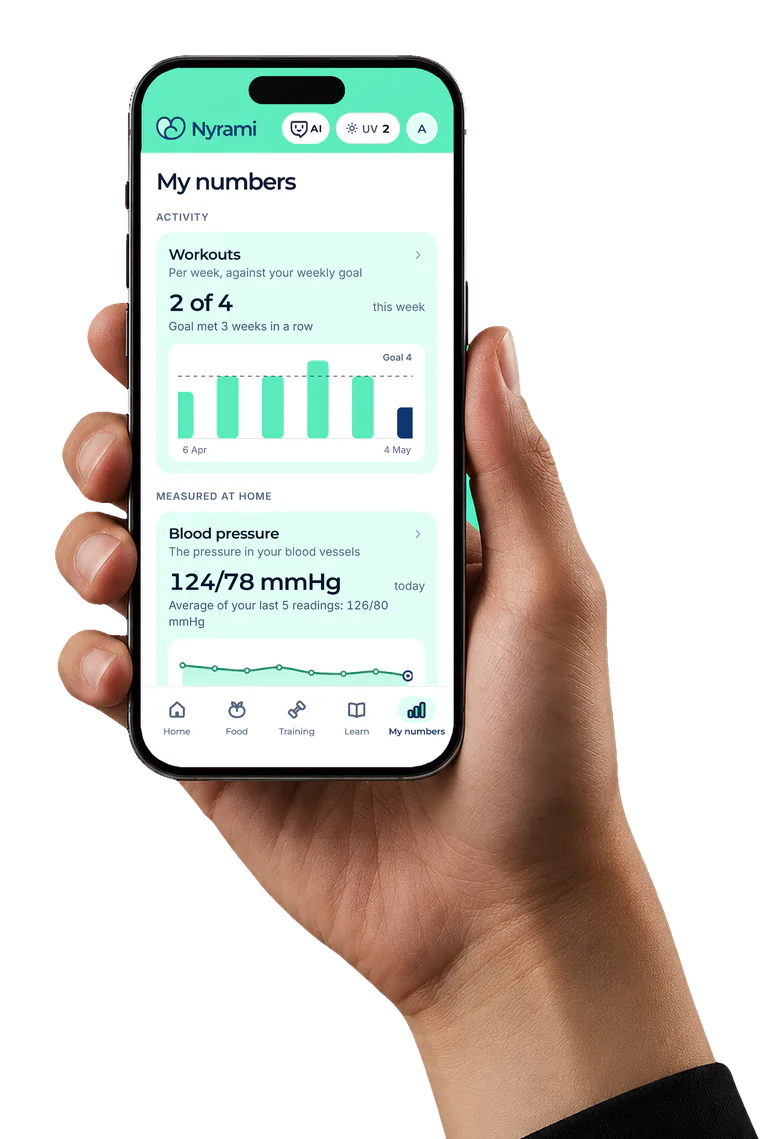
In the Nyrami app you can log what you drink through the day and your weight, and see them over time alongside your values. That makes it easier to see whether your weight is rising because your body is holding on to water. The food scanner assesses sodium, potassium, phosphorus and protein for you, which makes it easier to eat less salt. Your fluid limit should be set by the doctor or nurse who follows you up.
Turns the advice into something you can use in the shop and the kitchen: scan food and see potassium, phosphorus and salt assessed for you, and follow your numbers over time. Free on iPhone and Android.