Potassium in food: chart of high and low potassium foods
The most potassium is found in dried fruit, brunost (Norwegian brown cheese), crisps, nuts, potatoes, avocado and banana. Apples, berries, rice, pasta and boiled vegetables are low in potassium. Boiling in plenty of water that you pour away can roughly halve the potassium. You only need to limit potassium if your blood tests or your doctor say so.
Potassium is a mineral your muscles and heart need to work. Healthy kidneys remove what the body does not need. When kidney function is severely reduced, or you take certain blood pressure medicines, the potassium in your blood can get too high. Then it can help to choose food with less potassium.
Many people with kidney disease have normal potassium and do not need a low-potassium diet. The limit depends on your blood tests. Do not cut out fruit and vegetables unless your doctor or dietitian has asked you to. If you cannot find your food in the tables here, search the food lookup, which shows potassium per 100 grams and per portion for more than 2,100 foods.
Per 100 grams, the most potassium is in dried fruit, brunost and prim (Norwegian whey cheese and whey spread), crisps, nuts and almonds, spinach, potatoes and avocado. Bananas also have a fair amount. The Norwegian clinical handbook Metodebok counts over 300 mg of potassium per 100 grams as high, 150 to 300 mg as medium and under 150 mg as low.
Foods high in potassium, mg per 100 grams
Food
Potassium (mg)
Brunost (Norwegian brown whey cheese)
1444
Apricots, dried
1300
Prim (soft Norwegian whey spread)
1233
Crisps (potato chips)
1220
Raisins
907
Almonds
745
Spinach, raw
735
Potato, baked
709
Peanuts
705
Avocado
583
Potato, maincrop, boiled
522
Salmon, farmed, raw
451
Banana
348
Source: Matvaretabellen 2026 (the Norwegian food composition table).
The portion matters as much as the number per 100 grams. A slice of bread with brunost (16 grams of cheese) gives around 230 mg of potassium. A portion of boiled potatoes (170 grams) gives almost 900 mg, and a baked potato gives even more.
How much potassium is in a banana?
A banana of around 120 grams gives about 420 mg of potassium, which is around 11 mmol. That is a lot for one piece of fruit. If you have been told to eat a low-potassium diet, where the daily target is often 1.5 to 3 grams, a whole banana is a large part of the day. Many people then choose half a banana, or fruit with less potassium, such as an apple, blueberries or pineapple. See the numbers for banana and other fruit in the food lookup.
Which foods are low in potassium?
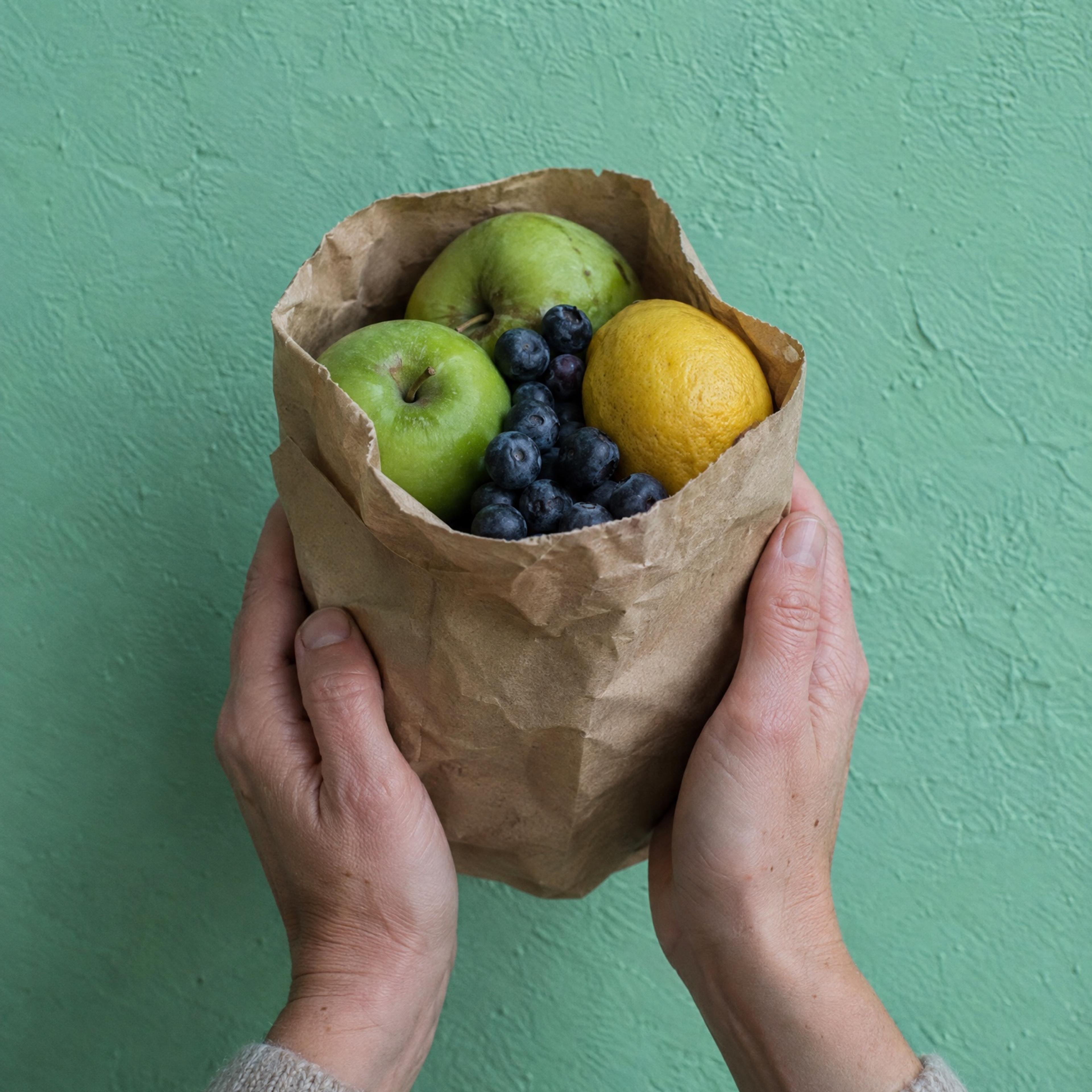
White rice and pasta, apples, berries such as blueberries and lingonberries, pineapple, watermelon, eggs, white bread and boiled vegetables such as carrot, swede and onion are low in potassium. These are good choices if you have been told to eat a low-potassium diet.
Foods low in potassium, mg per 100 grams
Food
Potassium (mg)
Rice, white long grain, boiled
10
Pasta, boiled
45
Yellow cheese (Norvegia, a mild Norwegian cheese)
77
Apple
82
Onion, boiled
82
Watermelon
100
Carrot, boiled
111
Lingonberries
118
Blueberries
122
Swede (rutabaga), boiled
122
Pineapple
123
Pepper, yellow, raw
123
Egg, boiled
132
White bread
149
Source: Matvaretabellen 2026. Yellow cheese is low in potassium, but high in phosphorus and salt. Green pepper is as low as yellow (120 mg), while red pepper is medium (216 mg). Carrot, swede and onion are medium in potassium when raw; boiling is what moves them here.
Is there potassium in eggs and oats?
Eggs are low in potassium: a boiled egg gives around 75 mg. Rolled oats have more, 413 mg per 100 grams, but a normal portion of one decilitre (40 grams) gives around 165 mg. Both can fit in a low-potassium diet. Porridge made with water gives less potassium than porridge made with milk, because one glass of milk alone gives around 350 mg.
How much potassium is in coffee, milk and juice?
Drinks give more potassium than many people think, because the glasses and cups add up over a day. A cup of coffee gives around 170 mg. NHI, the Norwegian health information service, writes that one litre of coffee a day can make up a third to half of the allowance if you are on a low-potassium diet. Tea, water and fizzy drinks have little. For beer and wine, see also alcohol and the kidneys.
Potassium in drinks, mg per glass or cup
Hot chocolate with semi-skimmed milk
Amount
Cup, 240 g
Potassium (mg)
727
Semi-skimmed milk
Amount
Glass, 200 g
Potassium (mg)
348
Orange juice
Amount
Glass, 200 g
Potassium (mg)
328
Apple juice
Amount
Glass, 200 g
Potassium (mg)
238
Coffee, filter
Amount
Cup, 170 g
Potassium (mg)
168
Lager
Amount
Half a litre
Potassium (mg)
150
Red wine
Amount
Glass, 120 g
Potassium (mg)
132
Tea, black
Amount
Cup, 240 g
Potassium (mg)
65
Cola
Amount
Can, 330 g
Potassium (mg)
0
Potassium in drinks, mg per glass or cup
Drink
Amount
Potassium (mg)
Hot chocolate with semi-skimmed milk
Cup, 240 g
727
Semi-skimmed milk
Glass, 200 g
348
Orange juice
Glass, 200 g
328
Apple juice
Glass, 200 g
238
Coffee, filter
Cup, 170 g
168
Lager
Half a litre
150
Red wine
Glass, 120 g
132
Tea, black
Cup, 240 g
65
Cola
Can, 330 g
0
Source: Matvaretabellen 2026, calculated from the content per 100 grams and the table's portion sizes.
How do you reduce potassium in potatoes and vegetables?
What works is peeling, cutting into small pieces, soaking and boiling in plenty of water that you pour away. Potassium passes into the water. Metodebok states that potassium can be reduced by fifty to sixty-five per cent when all the steps are followed. Frying, oven baking and microwaving keep most of the potassium.
Peel the potatoes or vegetables.
Cut them into small pieces or slices, so more of the surface meets the water.
Soak the pieces in water for a while before cooking. NHI suggests leaving potatoes in water overnight.
Boil in plenty of fresh water.
Pour away the cooking water, and do not use it in sauce or soup.
Matvaretabellen shows how much difference boiling makes for vegetables. NHI counts cauliflower and carrot, among others, as high in potassium when raw. Boiled vegetables have about half as much potassium:
Potassium in raw and boiled vegetables, mg per 100 grams
Broccoli
Raw
385
Boiled
195
Cauliflower
Raw
300
Boiled
150
Swede (rutabaga)
Raw
255
Boiled
122
Carrot
Raw
233
Boiled
111
Beetroot
Raw
411
Boiled
223
Onion
Raw
185
Boiled
82
Potassium in raw and boiled vegetables, mg per 100 grams
Vegetable
Raw
Boiled
Broccoli
385
195
Cauliflower
300
150
Swede (rutabaga)
255
122
Carrot
233
111
Beetroot
411
223
Onion
185
82
Source: Matvaretabellen 2026, Norwegian produce.
For potatoes, Matvaretabellen gives the same amount of potassium in boiled as in raw potatoes, 522 mg per 100 grams for maincrop potatoes. That is because the figure for boiled potato is calculated without any loss to the cooking water. Boiling in plenty of water still works, but for potatoes it is the cutting, soaking and plenty of cooking water that have to do the job. Baked potato (709 mg), chips and crisps are high in potassium because nothing is boiled out.
Dried beans and lentils should be soaked overnight, and the water changed before and preferably during cooking.
NHI also gives this advice: pour away the liquid from tinned fruit and vegetables, and choose frozen vegetable mixes, which have less potassium than raw vegetables.
What raises potassium in the body?
The most common cause of high potassium is reduced kidney function. Certain medicines also raise potassium, including ACE inhibitors, angiotensin II receptor blockers and aldosterone antagonists, which many people with kidney disease and heart disease take because they protect the kidneys and the heart. Do not stop such medicines yourself. Talk to your doctor.
Some sources of potassium are easy to overlook:
Salt substitutes with potassium chloride, such as Seltin (a common salt substitute in Norway). The Norwegian Directorate of Health advises against them with chronic kidney disease. Read more in the guide on salt and the kidneys.
Juice gives a lot of potassium per glass. A glass of orange juice gives over 300 mg.
Processed food can have added potassium. KDIGO points out that potassium from processed food, meat, dairy products and juice is absorbed more easily than potassium from fresh fruit and vegetables.
Dietary supplements can contain potassium. Read the ingredient list.
Rapid weight loss can break down muscle, and potassium is then released from the muscles, NHI writes.
Is there medicine for high potassium?
Yes. Potassium binders are prescription powders that you mix in water and drink. They bind potassium in the gut, so it leaves with the stool instead of being absorbed into the blood. In Norway, sodium zirconium cyclosilicate (Lokelma) and patiromer (Veltassa) are used. KDIGO 2024 lists potassium binders as one way to handle high potassium in people who take kidney-protecting blood pressure medicines, so they can keep taking the medicine instead of stopping. Your doctor decides whether they suit you. Read more about medicines with kidney disease.
How much potassium do you need a day?
Healthy adults are advised to get around 3.5 grams of potassium a day. In the latest national diet survey in Norway, Norkost 4, men got around 4.2 grams and women around 3.3 grams. If you are told to eat a low-potassium diet, the goal is often 1.5 to 3 grams a day, according to NHI and Metodebok. Your doctor or dietitian decides the amount you should have based on your blood tests and your stage.
What are the symptoms of too much potassium in the blood?
High potassium often gives few or no clear symptoms, and is usually found on a blood test. When it is noticed, it is typically as muscle weakness and heavy arms and legs, and in severe cases paralysis and an irregular heartbeat. The most dangerous part is disturbances in the heart rhythm.
The Norwegian medical encyclopedia Store medisinske leksikon grades high potassium like this: mildly raised 5.1 to 5.9 mmol/l, moderate 6.0 to 6.9 mmol/l and severe from 7.0 mmol/l. Hospital laboratories often have a lower upper limit, for example 4.6 mmol/l for serum potassium at Oslo University Hospital, so a value of 4.8 may be flagged as high on your result. Mildly raised potassium is usually handled with diet and a review of your medicines, but your doctor should assess it. A sample can also show falsely high potassium if it has stood too long before analysis, so the doctor often takes a new sample.
What are the symptoms of too little potassium?
Too little potassium in the blood rarely causes problems until the value is below about 3.0 mmol/l. Then you may feel weak and have nausea and constipation, and at very low values paralysis and heart rhythm disturbances. The most common cause is water tablets (diuretics), but vomiting and diarrhoea can also cause low potassium. Do not take potassium supplements unless your doctor has asked you to, especially not when you have kidney disease.
When is it urgent?
Call 113, the Norwegian emergency number, if you have chest pain, faint, feel your heart beating very irregularly or suddenly lose strength in your arms or legs.
Contact a doctor the same day, or the out-of-hours doctor (legevakt) on 116 117, if you have been told your potassium is high and you feel muscle weakness or palpitations.
Get in touch with your doctor if your potassium has been raised on several tests, so that your diet and medicines can be reviewed.
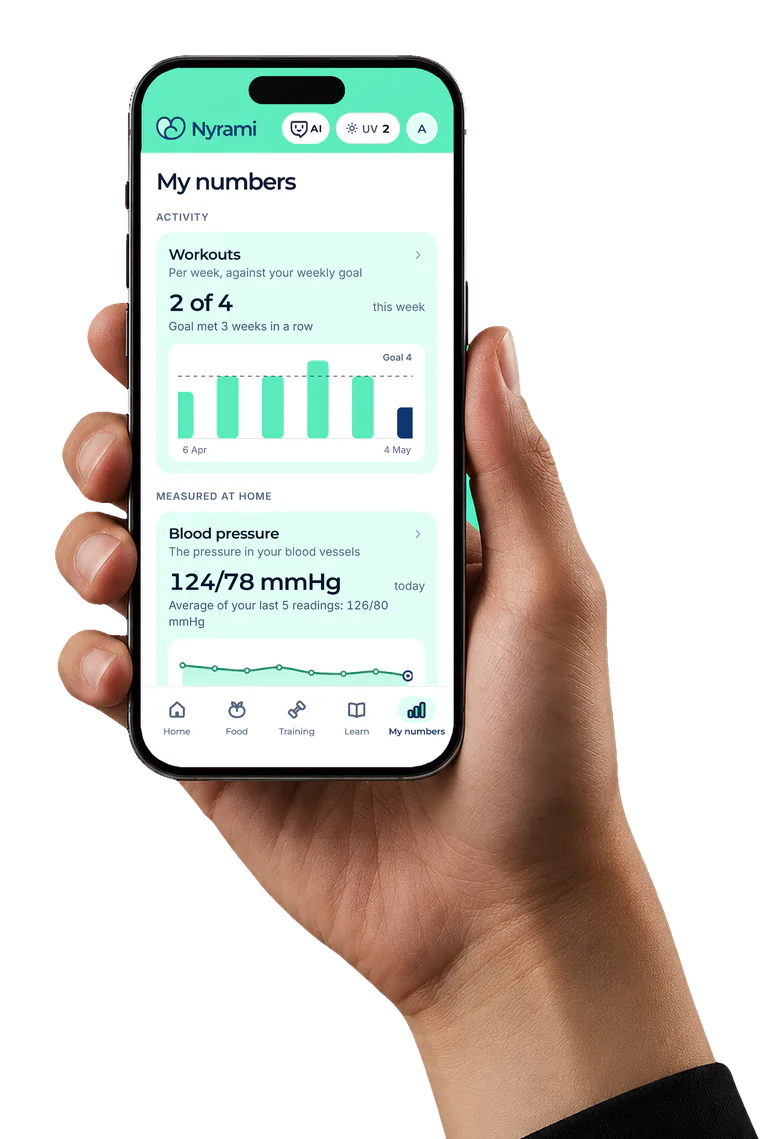
With the food scanner in the Nyrami app, you scan the barcode in the shop and see the potassium content assessed for you. The 148 recipes in the app are assessed per portion, so you see the potassium before you cook. The app is free for iPhone and Android.
Turns the advice into something you can use in the shop and the kitchen: scan food and see potassium, phosphorus and salt assessed for you, and follow your numbers over time. Free on iPhone and Android.