Blood tests in kidney disease and failure: what results mean
In kidney disease the same tests come back again and again: creatinine and eGFR for kidney function, urine albumin for leakage, and potassium, phosphate, calcium, PTH, haemoglobin and bicarbonate for what the kidneys regulate. Ranges vary a little between laboratories, and the trend over time says most.
A test result in kidney disease can have ten or twenty lines of abbreviations, numbers and small H and L flags. This page is a guide to the values you meet most often, what it can mean when they are high or low, and what you can ask your doctor. Three of them have their own, more detailed guides: eGFR, creatinine and albumin in the urine.
Which blood tests are taken in kidney failure?
In chronic kidney disease there are two kinds of tests: those that measure how well the kidneys filter, and those that show whether the body can keep its salts, blood and acid in balance. The lower the eGFR, the more tests are taken, because high potassium, high phosphate, anaemia and too much acid in the blood become more common as kidney function falls.
Common tests in kidney disease
Creatinine
Usual reference range, adults
Women 45 to 90 µmol/l, men 60 to 105 µmol/l
What a deviation can mean
High: reduced kidney function, but also a lot of muscle, a meat meal or dehydration.
eGFR
Usual reference range, adults
Above 90 ml/min/1.73 m², often lower in older people
What a deviation can mean
Below 60 for at least three months means chronic kidney disease.
Cystatin C
Usual reference range, adults
0.64 to 1.23 mg/l
What a deviation can mean
High: reduced kidney function. Affected by thyroid function and steroids.
u-AKR (urine test)
Usual reference range, adults
Below 3 mg/mmol
What a deviation can mean
High: the kidney filters are leaking albumin. 3 to 30 is moderately increased, above 30 severely increased.
Urea (carbamide)
Usual reference range, adults
About 2.6 to 8.1 mmol/l, by age and sex
What a deviation can mean
High: reduced kidney function, dehydration or increased breakdown of protein.
Potassium
Usual reference range, adults
About 3.5 to 4.6 mmol/l in hospitals, 3.6 to 5.0 at some private laboratories
What a deviation can mean
High: reduced kidney function, some medicines or a problem with the sample. Low: water tablets, vomiting, diarrhoea.
Phosphate
Usual reference range, adults
About 0.75 to 1.65 mmol/l, by age and sex
What a deviation can mean
High: reduced kidney function. Low: among other things undernutrition and vitamin D deficiency.
Calcium
Usual reference range, adults
2.15 to 2.51 mmol/l
What a deviation can mean
Low: reduced kidney function with high phosphate, vitamin D deficiency. Interpreted together with albumin.
PTH (parathyroid hormone)
Usual reference range, adults
1.2 to 8.4 pmol/l
What a deviation can mean
High: secondary hyperparathyroidism in kidney failure or vitamin D deficiency.
Haemoglobin (Hb)
Usual reference range, adults
Women 11.7 to 15.3 g/dl, men 13.4 to 17.0 g/dl
What a deviation can mean
Low: anaemia, which is common in kidney failure.
Bicarbonate (HCO3)
Usual reference range, adults
22 to 26 mmol/l in arterial blood, slightly higher in blood from a vein
What a deviation can mean
Low: metabolic acidosis, too much acid in the blood.
Common tests in kidney disease
Test
Usual reference range, adults
What a deviation can mean
Creatinine
Women 45 to 90 µmol/l, men 60 to 105 µmol/l
High: reduced kidney function, but also a lot of muscle, a meat meal or dehydration.
eGFR
Above 90 ml/min/1.73 m², often lower in older people
Below 60 for at least three months means chronic kidney disease.
Cystatin C
0.64 to 1.23 mg/l
High: reduced kidney function. Affected by thyroid function and steroids.
u-AKR (urine test)
Below 3 mg/mmol
High: the kidney filters are leaking albumin. 3 to 30 is moderately increased, above 30 severely increased.
Urea (carbamide)
About 2.6 to 8.1 mmol/l, by age and sex
High: reduced kidney function, dehydration or increased breakdown of protein.
Potassium
About 3.5 to 4.6 mmol/l in hospitals, 3.6 to 5.0 at some private laboratories
High: reduced kidney function, some medicines or a problem with the sample. Low: water tablets, vomiting, diarrhoea.
Phosphate
About 0.75 to 1.65 mmol/l, by age and sex
High: reduced kidney function. Low: among other things undernutrition and vitamin D deficiency.
Calcium
2.15 to 2.51 mmol/l
Low: reduced kidney function with high phosphate, vitamin D deficiency. Interpreted together with albumin.
PTH (parathyroid hormone)
1.2 to 8.4 pmol/l
High: secondary hyperparathyroidism in kidney failure or vitamin D deficiency.
Haemoglobin (Hb)
Women 11.7 to 15.3 g/dl, men 13.4 to 17.0 g/dl
Low: anaemia, which is common in kidney failure.
Bicarbonate (HCO3)
22 to 26 mmol/l in arterial blood, slightly higher in blood from a vein
Low: metabolic acidosis, too much acid in the blood.
Source: Fürst medical laboratory, Oslo University Hospital (Metodebok), Helsedirektoratet, KDIGO 2024. Reference ranges vary between laboratories and with age and sex. Always use the range printed on your own result.
What do creatinine, eGFR and albumin tell you?
Creatinine, eGFR and albumin in the urine are the three measures of the kidneys themselves. eGFR is calculated from creatinine, age and sex, and is used to divide chronic kidney disease into stages. Albumin in the urine, measured as the albumin to creatinine ratio (u-AKR, often called ACR in English) in mg/mmol, shows whether the kidney filters are leaking, and is often the first sign of damage. Together they say most about how fast the disease may progress.
Cystatin C is a small protein made by almost every cell in the body and filtered out by the kidneys. It is much less affected by muscle mass than creatinine. That is why it is used especially in people with little muscle, such as those over 80, children and people with a low body weight, and when eGFR is below 30 and medicine doses need adjusting. The laboratory then calculates a separate eGFR from cystatin C.
Cystatin C does not suit everyone. It is higher with an overactive thyroid, steroid treatment and pregnancy, and lower with an underactive thyroid.
What is urea (carbamide), and what does a high value mean?
Urea and carbamide are two names for the same substance (in Norwegian also urinstoff). It is a waste product made in the liver when the body breaks down protein, and the kidneys remove it in the urine. On Norwegian results it often appears as S-Urinstoff or P-Karbamid.
High urea can mean reduced kidney function, but it also rises with dehydration and when the body breaks down a lot of protein, for example with fever, after an operation or during bed rest. That is why it is always interpreted together with creatinine and eGFR. Low urea is seen in, among other things, liver failure and pregnancy.
What does high potassium in the blood mean?
Potassium is a salt that controls the muscles and the heart rhythm, and the kidneys are the main way out of the body. When kidney function is low, potassium can build up. Very high potassium can cause dangerous heart rhythm problems.
The reference range varies: hospital laboratories use about 3.5 to 4.6 mmol/l, while some private laboratories use 3.6 to 5.0. Check the range on your own result. A high result can also be false: Fürst states that the most common cause of high potassium on a result is poor handling of the sample during collection, storage or transport. Your doctor will then often repeat the test. ACE inhibitors and ARBs can also raise potassium. Read what you can do with food in Potassium in food.
What do phosphate, calcium and high PTH mean in kidney disease?
Phosphate, calcium and PTH are linked and affect both the skeleton and the blood vessels. Phosphate leaves the body only through the kidneys, so it rises as kidney function falls. At the same time the kidneys are less able to make active vitamin D, and calcium can become low. The body responds by making more PTH, a hormone from the parathyroid glands in the neck. This is called secondary hyperparathyroidism.
In kidney failure it is common for PTH to be above the reference range. Helsedirektoratet writes that a PTH of two to three times the upper limit is accepted in kidney failure, but that high PTH over time increases bone turnover and the risk of fractures. High phosphate over time causes calcification in the blood vessels and raises the risk of heart and blood vessel disease. Treatment may include less phosphorus in food, phosphate binders with meals and active vitamin D, and it is managed by your kidney specialist. Read more in Phosphorus in food.
Why do people get anaemia with kidney disease?
Anaemia, or low haemoglobin, is common in kidney failure because diseased kidneys make too little of the hormone erythropoietin (EPO), which tells the bone marrow to make red blood cells. The red blood cells also live for a shorter time. Anaemia can cause tiredness, breathlessness on exertion and less stamina.
Your doctor first looks for other causes, such as iron deficiency or bleeding. Iron stores are topped up, sometimes with iron into a vein, and if needed you get EPO as an injection. Helsedirektoratet recommends starting EPO before haemoglobin falls below 10 g/dl, with a target of 10 to 12 g/dl. It usually becomes relevant when eGFR is below 45. Ferritin and transferrin saturation are used to assess iron stores, but ferritin can be falsely high in kidney failure.
What does low bicarbonate mean?
Low bicarbonate means there is too much acid in the blood, called metabolic acidosis. Healthy kidneys get rid of acid and hold on to bicarbonate, which is the body's buffer. In advanced kidney failure they cannot do this as well. The reference range is about 22 to 26 mmol/l.
The international KDIGO guideline recommends considering treatment when bicarbonate is below 18 mmol/l in adults, with tablets and sometimes changes to the diet. Treatment is followed with new tests, so that bicarbonate does not become too high.
Why does the trend matter more than one number?
A single test result is a snapshot. What says most about how things are going is the direction over time. An eGFR that stays stable at 45 for four years is a very different situation from one that has fallen from 60 to 45 in one year, even though today's number is the same.
Many values vary a little from one test to the next. Dehydration, an infection, a large meat meal or hard exercise can cause a temporary deviation. A small H or L does not always mean disease either: the reference range is set so that about one in twenty healthy people get a value outside it. Look at several results in a row, and ask your doctor what is normal for you.
How often are the tests taken?
How often you have tests depends on your eGFR, the amount of albumin in your urine and how fast the values change. With mildly reduced kidney function and little albumin, one check a year is often enough. The lower the eGFR and the more albumin, the more often you are checked, often several times a year. Everyone with diabetes should have eGFR and u-AKR at least once a year. See Stages of chronic kidney disease and Diabetic kidney disease.
What can you ask your doctor?
How have my eGFR and urine albumin changed since last time?
Which stage am I in, and what does it mean for me?
Are my potassium and phosphate fine, and do I need to think about food?
Do I have anaemia, and if so, what can be done?
What is my blood pressure target?
When should I have my next tests, and what will we look for then?
When should you contact a doctor?
The laboratory or your doctor contacts you about a very abnormal result, for example potassium above 6.5 mmol/l: follow the advice you get the same day.
You have had high potassium and get muscle weakness, an irregular heartbeat or feel unusually unwell: contact a doctor or the out-of-hours service (legevakt, 116 117) straight away.
You become very tired and short of breath with little effort. It may be anaemia.
Your eGFR has fallen clearly since the last test, or albumin in your urine has increased: ask for a new assessment.
For chest pain or severe breathlessness: call 113. Read more about the condition in Chronic kidney disease.
How Nyrami can help
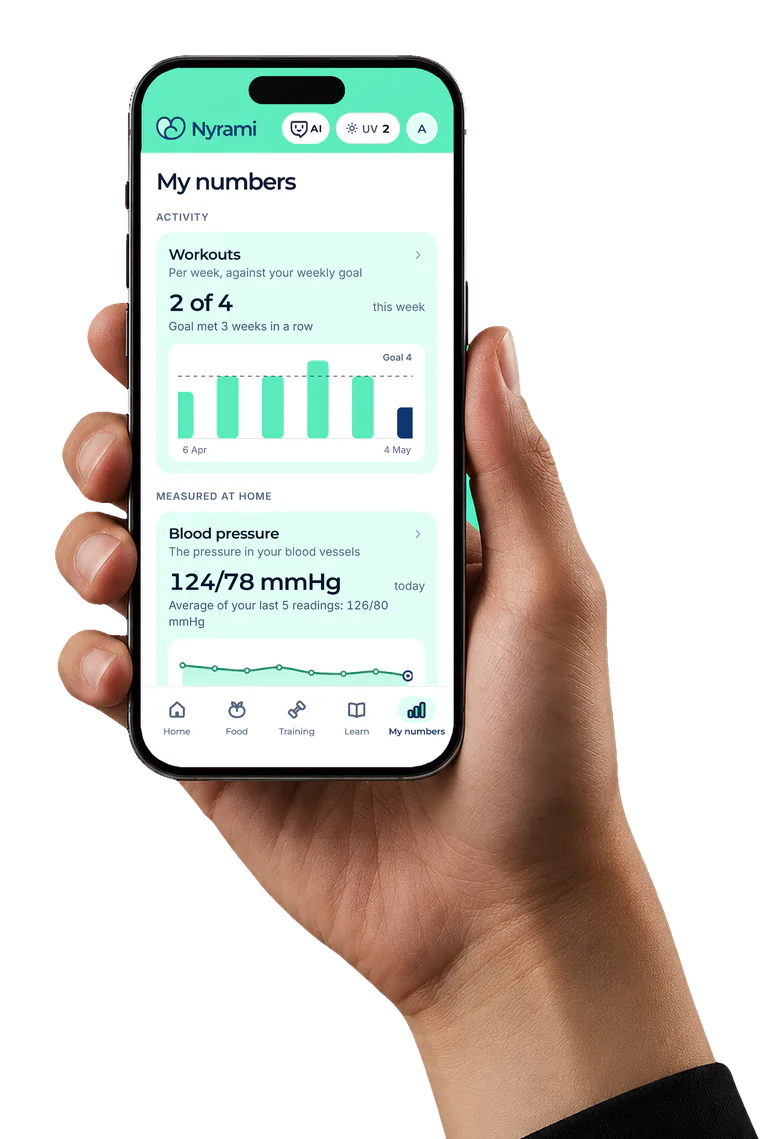
In the Nyrami app you can log eGFR, creatinine and albumin after each check-up and see the trend over time, so you can see the direction and know what to ask. If you have been given advice about potassium or phosphorus, the food scanner assesses potassium, phosphorus, sodium and protein in food for you. The app is free for iPhone and Android.
Turns the advice into something you can use in the shop and the kitchen: scan food and see potassium, phosphorus and salt assessed for you, and follow your numbers over time. Free on iPhone and Android.