Phosphorus in food: chart, phosphate E numbers, CKD advice
Cheese, milk, meat, fish, eggs, nuts and seeds are high in phosphorus. Added phosphate in sausages, sliced meats, processed cheese and ready meals is almost fully absorbed by the body, while phosphorus from grains and pulses is absorbed less well. If your phosphate is high, the first step is to cut food with phosphate E numbers.
Phosphorus is found in almost all food, and most of all in protein-rich food. In the early stages of kidney disease, the phosphate in your blood is usually normal. Whether and how much you should limit it is decided by your blood tests. To check a particular food, search the food lookup, which shows phosphorus per 100 grams and per portion for more than 2,100 foods.
What does phosphorus do in the body?
Phosphorus builds bones and teeth and is needed in every cell to make energy. Healthy kidneys remove what the body does not need. When kidney function becomes more reduced, and especially on dialysis, the kidneys cannot remove enough, and phosphate builds up in the blood.
What happens when phosphate is too high?
High phosphate is rarely felt, but does harm over time. It disturbs the parathyroid glands, which control calcium in the body, and when both calcium and phosphate are high, they can be deposited in the walls of blood vessels, in muscles and in other soft tissue. LNT, the Norwegian kidney patient association, writes that high phosphate levels are an important risk factor for brittle bones and cardiovascular disease. Many people on dialysis are also troubled by itching, and lowering phosphate is one of the measures hospitals use. Read more about itching and other problems in symptoms of kidney failure.
What is the difference between phosphorus and phosphate?
Phosphorus is the element, and phosphate is the form it takes in food and in the body. The Norwegian food composition table (Matvaretabellen) and nutrition labels give phosphorus, while your blood test measures phosphate. In practice it is the same thing: when your doctor says your phosphate is high, it means your kidneys cannot remove enough of the phosphorus you take in.
Which foods are high in phosphorus?
The most phosphorus is in cheese, seeds and nuts, meat, fish, eggs, milk and whole grains. Processed meat and cheese spread can have more than fresh ingredients. Still, the number per 100 grams does not tell the whole story, because the body absorbs phosphorus from different sources very differently.
Source: Matvaretabellen 2026 (the Norwegian food composition table).
Notice the difference between cooked ham (430 mg) and fried pork loin (255 mg). Processed meat products often have added phosphate, and that is the type of phosphorus the body absorbs best.
How much phosphorus is in milk, cheese and eggs?
A glass of semi-skimmed milk (200 ml) gives around 230 mg of phosphorus. A slice of bread with yellow cheese (20 grams) gives around 120 mg, a slice with brunost (16 grams, Norwegian brown whey cheese) around 100 mg, and a boiled egg around 110 mg. Phosphorus from milk, cheese and eggs is well absorbed in the gut, so with high phosphate it is often the amount of exactly these foods that is limited. See the examples from Metodebok further down.
Why is added phosphate worse than natural phosphorus?
Added phosphate is almost fully absorbed in the gut, ninety per cent or more. From meat, fish, eggs and milk, about half or more is absorbed, and from grains, beans and nuts often only thirty to forty per cent, because the phosphorus is bound in phytate. That is why a piece of fresh meat and a slice of sausage are not the same, even if the numbers look similar.
A review by Cupisti and Kalantar-Zadeh describes how added phosphate can make up a large share of the phosphorus we take in. Cutting added phosphate is therefore often the easiest place to start, because you keep the protein from fresh ingredients.
Which E numbers are phosphate?
The most common phosphate additives have the E numbers E338 to E341, E343, E450 to E452 and E541. Phosphated starches (E1410 and E1412 to E1414) also contain phosphate. If one of these, or a word containing «phosphate», is in the ingredient list, the product has added phosphate. It is used to bind water in meat and fish, as an emulsifying salt in cheese, as an acidity regulator in fizzy drinks and as a raising agent.
The most common phosphate additives in the ingredient list
E number
Name
E338
Phosphoric acid
E339
Sodium phosphates
E340
Potassium phosphates
E341
Calcium phosphates
E343
Magnesium phosphates
E450
Diphosphates
E451
Triphosphates
E452
Polyphosphates
E541
Sodium aluminium phosphate
E1410, E1412 to E1414
Phosphated starches
Potassium and sodium phosphates also add potassium or sodium.
Added phosphate is found especially in sliced meats, sausages, meatballs, ready meals, processed cheese and cheese spread, some fizzy drinks and many baked goods. Some plant-based drinks also have added phosphate. NHI, the Norwegian health information service, advises drinking at most 300 ml a day of plant-based drinks and similar products if phosphate is in the ingredient list.
Is there phosphate in cola, Pepsi Max and Coke Zero?
Yes. Regular cola, Pepsi Max and Coca-Cola Zero Sugar all have phosphoric acid (E338) in the ingredient list. The amount is not large: Matvaretabellen gives 15 mg of phosphorus per 100 grams in regular cola and 9 mg in diet cola, but phosphoric acid is almost fully absorbed. If your phosphate is high, it is wise to choose water, coffee, tea or fizzy drinks without phosphoric acid. Aalborg University Hospital advises kidney patients with high phosphate to avoid cola. For beer and other drinks, see alcohol and the kidneys.
Which foods are low in phosphorus?
Fruit, berries, most vegetables, white rice, pasta, white bread, butter and cream cheese are low in phosphorus. Fresh meat and fish without additives are better choices than sliced meats and sausages, even though they also contain phosphorus. Remember that food low in phosphorus is not always low in potassium; see potassium in food if you also need to limit potassium.
Rice, boiled: 43 mg per 100 grams.
Pasta, boiled: 59 mg per 100 grams.
Cream cheese (Philadelphia): 95 mg per 100 grams, compared with 590 mg in yellow cheese.
Carrot, boiled: 22 mg per 100 grams.
Apple: 6 mg per 100 grams.
Boiling in water also lowers the phosphorus content. According to the review by Cupisti and Kalantar-Zadeh, long boiling can reduce phosphorus by up to around half in vegetables and pulses and around a third in meat.
With high phosphate, the Norwegian clinical handbook Metodebok gives practical examples such as up to one small glass of milk or one yoghurt a day, up to one slice of cheese a day and up to two eggs a week. These are examples. Your own plan should be made with a clinical dietitian, because you also need to get enough protein. Cutting protein to lower phosphate can lead to muscle loss.
What are phosphate binders?
Phosphate binders are medicines you take with your meals. They bind phosphate in the gut, so less is absorbed into the blood. They are used when diet alone does not keep phosphate down, most often in advanced kidney disease and on dialysis.
Your doctor decides whether you need phosphate binders, which type and how much. It is important to take them as you have been told, with your food, and to speak up if they cause problems. Phosphate binders do not replace the diet advice, but work best together with it. Read more in life on dialysis.
When should you contact a doctor?
High phosphate rarely gives symptoms you notice yourself, and is found on blood tests. Talk to your doctor if your phosphate has been high on several tests, if you have trouble taking your phosphate binders, or if you are unsure what you can eat. See also understand your test results and the bigger picture in food with kidney failure.
How Nyrami can help
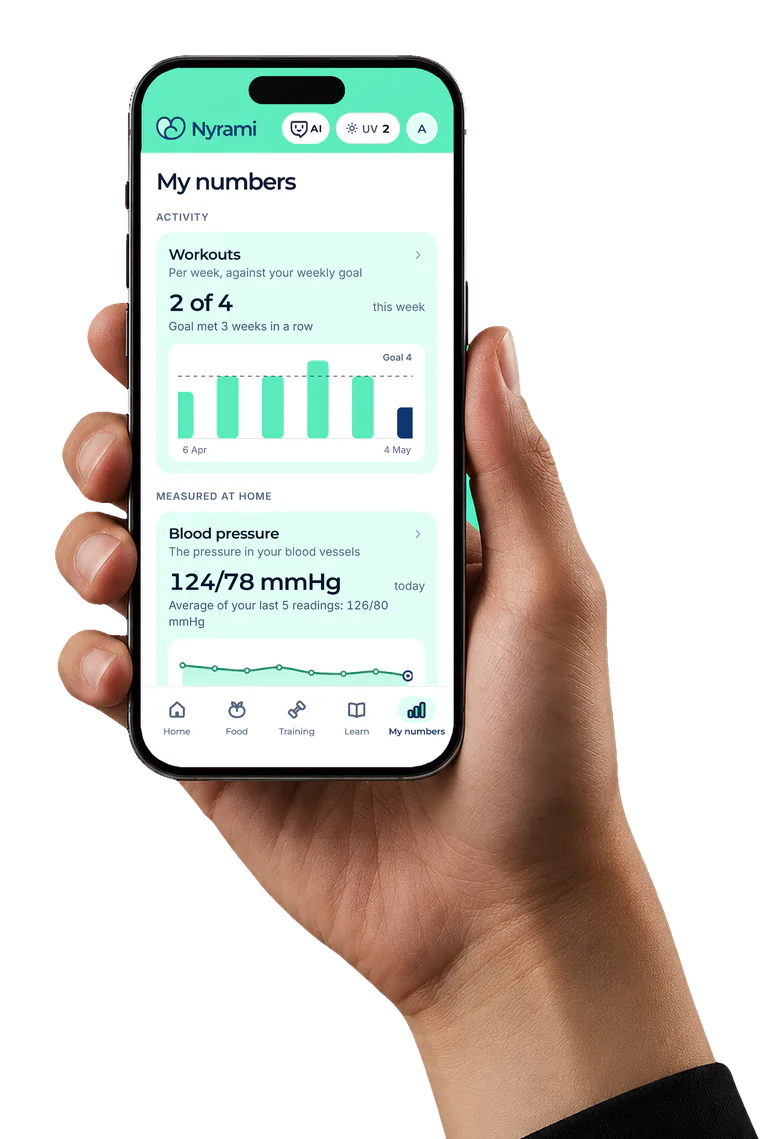
The food scanner in the Nyrami app reads the barcode and assesses the phosphorus content for you, together with potassium, sodium and protein. The 148 recipes in the app are also assessed per portion. The app is free for iPhone and Android.
Turns the advice into something you can use in the shop and the kitchen: scan food and see potassium, phosphorus and salt assessed for you, and follow your numbers over time. Free on iPhone and Android.