Life on dialysis: diet, fluids, energy and everyday life
Haemodialysis usually takes three to five hours, three times a week, and the days can feel very different. Your diet changes: you need more protein, but often have to watch potassium, phosphorus, salt and fluids. With some planning it is possible to work, travel and have good days.
Starting dialysis is a big change, and it is as much about your timetable and energy as about medicine. This article is about everyday life: what a dialysis day is like, what you can eat and drink, and how work, travel and mood can go. If you want to know what dialysis is and which types there are, read Dialysis. The question of life expectancy is answered in How long can you live on dialysis?
What is a dialysis day like?
Most people on haemodialysis have treatment three times a week, and each session usually lasts three to five hours. On top of that comes the journey and the time before and after. Many people think of a dialysis day as a working day.
You are weighed before treatment. The weight gained since last time shows roughly how much fluid needs to be removed.
The nurse puts two needles into the fistula in your arm, or connects the machine to a dialysis catheter. If the needles hurt, you can ask for an anaesthetic cream, which needs to go on at least an hour before.
Your blood passes through the filter in the machine and back to you. Your blood pressure is measured along the way.
Afterwards you are weighed again, and the needles are removed.
The cleaning itself does not hurt. Some people get a drop in blood pressure, muscle cramps, headache or nausea, especially at first and when a lot of fluid has to be removed. This can often be adjusted, so tell the staff.
Peritoneal dialysis (bag dialysis) is done at home. You change the fluid in your abdomen four to five times a day, or a machine does it while you sleep. At the end of 2024, about one in four people on dialysis in Norway had their treatment at home.
Why are you so tired, and what helps?
Many people feel worn out straight after haemodialysis and have the most energy the day after. Put demanding appointments, exercise and social plans on the good days, rather than fighting the pattern.
Tiredness that lasts should still be checked. Anaemia (low haemoglobin) is common in kidney failure and can be treated: nearly half of those who started dialysis or received a new kidney in 2024 had haemoglobin below 10 g/dl when they started. Poor sleep, itching, leg cramps and low mood can also drain your strength. Physical activity helps many people, including exercise during dialysis itself. See Exercise with kidney disease.
What can you eat and drink on dialysis?
When you start dialysis you need more protein, not less, because the treatment removes protein from the body. At the same time many people need to watch potassium, phosphorus, salt and fluids. The advice you got before dialysis may therefore no longer apply. Ask for a new review with a clinical dietitian when you start.
Food and drink on dialysis
Protein
Haemodialysis
Your needs go up. If your appetite is poor, have eggs, fish, meat, cheese or milk at every meal.
Peritoneal dialysis
Your needs go up, according to LNT at least 1.2 grams per kilo of body weight a day.
Potassium
Haemodialysis
Often needs limiting. Too much potassium can cause dangerous heart rhythm problems.
Peritoneal dialysis
Causes problems less often.
Phosphorus
Haemodialysis
Limit phosphorus rich food, and take your phosphate binders with meals.
Peritoneal dialysis
As for haemodialysis.
Salt
Haemodialysis
Be careful. Salt makes you thirsty.
Peritoneal dialysis
Be careful.
Fluids
Haemodialysis
Often around 700 ml a day plus what you pass as urine.
Peritoneal dialysis
Your doctor decides whether you need a limit.
Food and drink on dialysis
Topic
Haemodialysis
Peritoneal dialysis
Protein
Your needs go up. If your appetite is poor, have eggs, fish, meat, cheese or milk at every meal.
Your needs go up, according to LNT at least 1.2 grams per kilo of body weight a day.
Potassium
Often needs limiting. Too much potassium can cause dangerous heart rhythm problems.
Causes problems less often.
Phosphorus
Limit phosphorus rich food, and take your phosphate binders with meals.
As for haemodialysis.
Salt
Be careful. Salt makes you thirsty.
Be careful.
Fluids
Often around 700 ml a day plus what you pass as urine.
Your doctor decides whether you need a limit.
Source: LNT (dietary advice on dialysis), St. Olavs hospital. Your own limits come from your dialysis unit and depend on your blood tests.
Most people on haemodialysis pass little or no urine, so what you drink stays in the body until the next session. St. Olavs hospital gives this as a starting point: if you pass no urine, you should not drink more than 700 ml a day, and if you still pass urine, you can drink 700 ml more than your urine volume. If you pass 400 ml of urine a day, for example, you can drink 1.1 litres.
If you keep to the limit, you get fewer drops in blood pressure and leg cramps during dialysis, and you feel less worn out. Soup, sauce, thin porridge and juicy fruit count too. Less salt means less thirst. You will find more advice in Fluids in kidney disease.
What can you do about itching?
Itching is common with kidney failure and on dialysis. The cause is not fully known, but a build up of waste products and high phosphate may play a part. Tell your dialysis unit, because help is available.
Use moisturiser, take lukewarm showers and use a mild soap.
Choose loose cotton clothes and bedding.
Take your phosphate binders and follow the advice on phosphorus. Sometimes longer dialysis helps.
Light therapy and medicines for itching may be options for some people. Ask your doctor.
Can you work and travel on dialysis?
Many people can work, but working full time is rarely easy. Most of those in work move to part time. Talk to your employer and your dialysis unit about fixed times that suit you, and ask whether home dialysis could give you more freedom. Peritoneal dialysis with a machine at night frees up the days for many people.
You can travel, but it takes planning. Contact the dialysis unit where you are going about two months ahead in Norway, and two to three months before a trip abroad. It is usually you or your family who book the place. In the EU and EEA you use the European Health Insurance Card and pay the same charge as local residents. Outside the EU and EEA you pay yourself and apply to Helfo for reimbursement, up to what the treatment would have cost in Norway. Read more about dialysis abroad on Helsenorge.
You can apply to Pasientreiser (patient travel) to have your journeys to and from treatment in Norway covered. The conditions are on Helsenorge.
How are you really doing?
It is common to feel low, angry or restless on dialysis. Life has a new timetable, and many people lose some of their work and social life. Low mood can also make you tired and disturb your sleep. Tell your doctor or nurse if it lasts. Help is available, and it is part of your treatment.
Many people find it helps to talk to someone who has been there. The Norwegian association for kidney patients and transplant recipients (Landsforeningen for nyrepasienter og transplanterte, LNT) has peer supporters who have lived with kidney disease and dialysis themselves, or who have been family members. Also read Cristian's story.
How can you use the hours on dialysis?
Bring a charger, headphones and a blanket. Many people feel cold during treatment.
Have something to look forward to: a series, a podcast, a book you only read there.
Plan what you will do knowing that the arm with the fistula has to stay still.
Get to know the others. For many, the people in the room become an unexpectedly good part of the week.
What can you do as a family member?
As a family member you may be driving to treatment, waiting, keeping an eye on the fluid limit at home and carrying much of the worry. That is a lot, and it is fine to say that you need help too.
Learn the fluid limit and what counts as fluid. Much of the food can be the same for the whole family.
Contact the dialysis unit and ask for a talk with a nurse or doctor if you are wondering about something.
Ask your municipality (kommune) about respite care if caring becomes heavy. Respite care is free and can be given at home or as a stay in an institution.
Talk to a peer supporter in LNT. They also have peer supporters for family members.
When should you contact the dialysis unit or a doctor?
You have gained a lot of weight since last time, are swollen or become short of breath.
The fistula or catheter becomes red, swollen or painful, or you get a fever.
You get muscle weakness, an irregular heartbeat or feel unusually unwell. It may be high potassium.
Outside opening hours you can call the out-of-hours service (legevakt) on 116 117. For chest pain or severe breathlessness: call 113.
How Nyrami can help
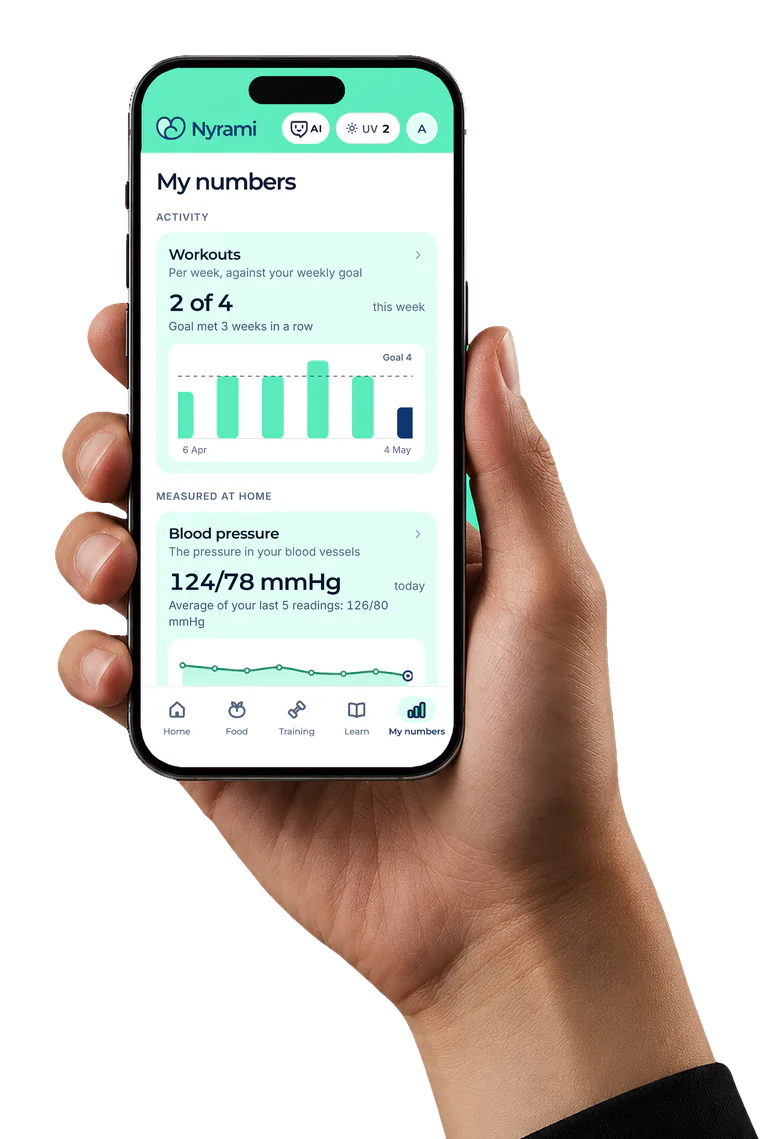
In the Nyrami app you can log your weight and fluids and see them alongside your values over time. The food scanner reads the barcode and assesses potassium, phosphorus, sodium and protein for you, and the recipes are assessed per portion. You can do the video workouts at your own pace on the good days.
Turns the advice into something you can use in the shop and the kitchen: scan food and see potassium, phosphorus and salt assessed for you, and follow your numbers over time. Free on iPhone and Android.