Salt and kidney disease: how much can you eat a day?
If you have kidney disease, less than 5 grams of salt a day is recommended, which is the same as less than 2 grams of sodium. Most Norwegians eat more. Most salt comes from bread, sliced meats, meat products and ready meals, not from the salt shaker. Avoid salt substitutes with potassium unless you have talked to your doctor.
Salt is the diet advice that applies to almost everyone with kidney disease, whatever the stage. Too much salt raises blood pressure and makes the body hold on to fluid. Both put strain on the kidneys. The good news is that salt is something you can do a lot about yourself.
How much salt should you eat with kidney disease?
With chronic kidney disease (CKD), the international KDIGO 2024 guideline recommends less than 5 grams of salt a day, which equals less than 2 grams of sodium. The low-salt diet from the Norwegian Directorate of Health (Helsedirektoratet), used for kidney disease and high blood pressure among other conditions, gives around 5 grams of salt a day. For comparison, the advice for healthy adults is just under 6 grams.
Five grams of salt is about one teaspoon, but it covers all the salt in the food you eat during the day, including what is already in the bread and the toppings. The body only needs around 1.5 grams of salt a day, according to NHI, the Norwegian health information service.
There is one exception: a few kidney diseases make the body lose salt. KDIGO points out that salt restriction is usually not suitable for these. Your doctor knows whether this applies to you.
How does salt affect kidney failure?
Salt makes the body hold on to fluid and raises blood pressure, and high blood pressure damages the small blood vessels in the kidneys. Less salt lowers blood pressure and can reduce the leakage of albumin, a protein, into the urine. KDIGO refers to studies where less salt in people with chronic kidney disease gave lower blood pressure and less albumin in the urine. High blood pressure and a lot of albumin in the urine are both linked to chronic kidney disease getting worse faster. The Norwegian guideline for GPs on chronic kidney disease says that cutting salt is especially important, precisely because of blood pressure. Read more about blood pressure and the kidneys, the kidneys and the heart and protein in urine.
Salt also makes you thirsty. If you have been told to limit fluid, for example on dialysis, it becomes much easier when you eat less salt. See fluid balance in kidney disease and, for beer and wine, alcohol and the kidneys.
What is the difference between sodium and salt?
Salt is sodium chloride, and sodium is the part of salt that affects blood pressure and fluid. 1 gram of sodium equals 2.5 grams of salt. To convert from salt to sodium, multiply by 0.4. To convert from sodium to salt, multiply by 2.5.
Converting between sodium and salt
Sodium
Salt
400 mg
1 gram
1 gram
2.5 grams
2 grams
5 grams
2.4 grams
6 grams
Salt (sodium chloride) is about forty per cent sodium.
On Norwegian food products, salt is listed in the nutrition declaration. On some imported products, and in some apps and diet advice, sodium is given instead. Then it is easy to underestimate the salt by a factor of 2.5.
How much salt do people eat in Norway?
Norwegian men eat around 10 to 11 grams of salt a day, and women just under 8 grams, according to urine measurements from the Tromsø Study and the HUNT Study. That is far above the advice for kidney disease. The Norwegian Directorate of Health refers to studies from Denmark, England and the USA suggesting that only ten to fifteen per cent of the salt comes from salt we add ourselves at the stove and at the table.
Where do you find hidden salt in Norwegian food?
According to the Norwegian diet survey Norkost 4, the biggest sources of salt in the Norwegian diet are meat and meat products, bread and salty seasonings. Cheese, fish toppings and ready-made sauces also add a lot. Each on its own is not much, but an ordinary day with open sandwiches and a ready meal quickly adds up to more than 5 grams.
Salt in common foods
Wholemeal bread, shop-bought
Salt per 100 g
1.1 g
Salt per portion
0.4 g per slice
Yellow cheese (Norvegia, a mild Norwegian cheese)
Salt per 100 g
1.2 g
Salt per portion
0.25 g per slice of bread
Leverpostei (Norwegian liver pâté)
Salt per 100 g
1.6 g
Salt per portion
0.3 g per slice of bread
Servelat (Norwegian sliced sausage)
Salt per 100 g
2.4 g
Salt per portion
0.2 g per slice
Salami
Salt per 100 g
4.9 g
Salt per portion
0.3 g per slice
Kaviar (Norwegian cod roe spread in a tube)
Salt per 100 g
5.5 g
Salt per portion
0.8 g per slice of bread
Smoked salmon
Salt per 100 g
3.1 g
Salt per portion
0.8 g per slice
Frankfurter (wienerpølse)
Salt per 100 g
2.0 g
Salt per portion
1.3 g per sausage
Kjøttkaker (Norwegian meat patties), shop-bought
Salt per 100 g
2.1 g
Salt per portion
3.2 g per portion
Pizza, shop-bought
Salt per 100 g
1.2 g
Salt per portion
3.6 g per portion
Soy sauce
Salt per 100 g
16.9 g
Salt per portion
2.2 g per tablespoon
Salt in common foods
Food
Salt per 100 g
Salt per portion
Wholemeal bread, shop-bought
1.1 g
0.4 g per slice
Yellow cheese (Norvegia, a mild Norwegian cheese)
1.2 g
0.25 g per slice of bread
Leverpostei (Norwegian liver pâté)
1.6 g
0.3 g per slice of bread
Servelat (Norwegian sliced sausage)
2.4 g
0.2 g per slice
Salami
4.9 g
0.3 g per slice
Kaviar (Norwegian cod roe spread in a tube)
5.5 g
0.8 g per slice of bread
Smoked salmon
3.1 g
0.8 g per slice
Frankfurter (wienerpølse)
2.0 g
1.3 g per sausage
Kjøttkaker (Norwegian meat patties), shop-bought
2.1 g
3.2 g per portion
Pizza, shop-bought
1.2 g
3.6 g per portion
Soy sauce
16.9 g
2.2 g per tablespoon
Source: Matvaretabellen 2026 (the Norwegian food composition table). Portion sizes from Matvaretabellen.
An example: four slices of wholemeal bread give around 1.8 grams of salt. Toppings on the four slices give around 1.5 grams. A portion of shop-bought meat patties gives over 3 grams. Then you are past 6 grams before you have added any salt yourself.
The Norwegian clinical handbook Metodebok counts over 1.25 grams of salt per 100 grams as a lot and under 0.25 grams as little. Compare products in the same category. The difference between two breads or two toppings can be large. In the food lookup you can see the salt per 100 grams and per portion in more than 2,100 foods, for example in stock powder, soy sauce and kaviar.
Are potassium salt substitutes dangerous with kidney disease?
Yes, they can be. In salt substitutes such as Seltin (a common salt substitute in Norway), some of the sodium is replaced with potassium chloride. When the kidneys cannot remove potassium, this can cause dangerously high potassium in the blood and disturb the heart rhythm. The Norwegian Directorate of Health does not recommend salt substitutes with potassium with chronic kidney disease.
The risk is greatest if your potassium is already high, if your kidney function is severely reduced, or if you take blood pressure medicines that raise potassium. Use herbs, salt-free spices, lemon, vinegar, garlic and pepper instead. Read more in potassium in food.
Sea salt, flaky salt and pink salt are just as much salt as ordinary table salt. Many herb salts also contain ordinary salt. Check the ingredient list.
How can you eat less salt?
Cook more from scratch with fresh ingredients, and use less stock, ready-made sauces and spice mixes with salt.
Choose low-salt toppings: egg, chicken, fresh cheese, thinly sliced cheese, vegetables and fruit instead of cured meats, kaviar and smoked salmon.
Compare bread and toppings by salt content per 100 grams.
Taste your food before you salt it, and take the salt shaker off the table.
Cut down gradually. NHI writes that the need for salt is often a habit, and many people notice that their taste gets used to less salt after a while.
Use recipes where the salt has been worked out in advance. In the Nyrami app, 148 recipes are assessed per portion, salt included.
How salt fits with the rest of your diet, with protein, potassium and phosphorus, is covered in food with kidney failure.
What are the signs of too much or too little salt?
Signs that the body is holding on to fluid after a lot of salt can be thirst, swelling in the ankles, feet, hands or face, rapid weight gain and higher blood pressure. Low sodium in the blood, on the other hand, is rarely caused by eating too little salt. According to NHI, it most often comes from too much water in the body, illness or medicines, especially diuretics.
Contact a doctor if you swell up, gain weight quickly or become short of breath. If you have been told your sodium is low and you become confused, vomit or have seizures, call 113, the Norwegian emergency number. Out-of-hours doctor (legevakt): 116 117.
How Nyrami can help
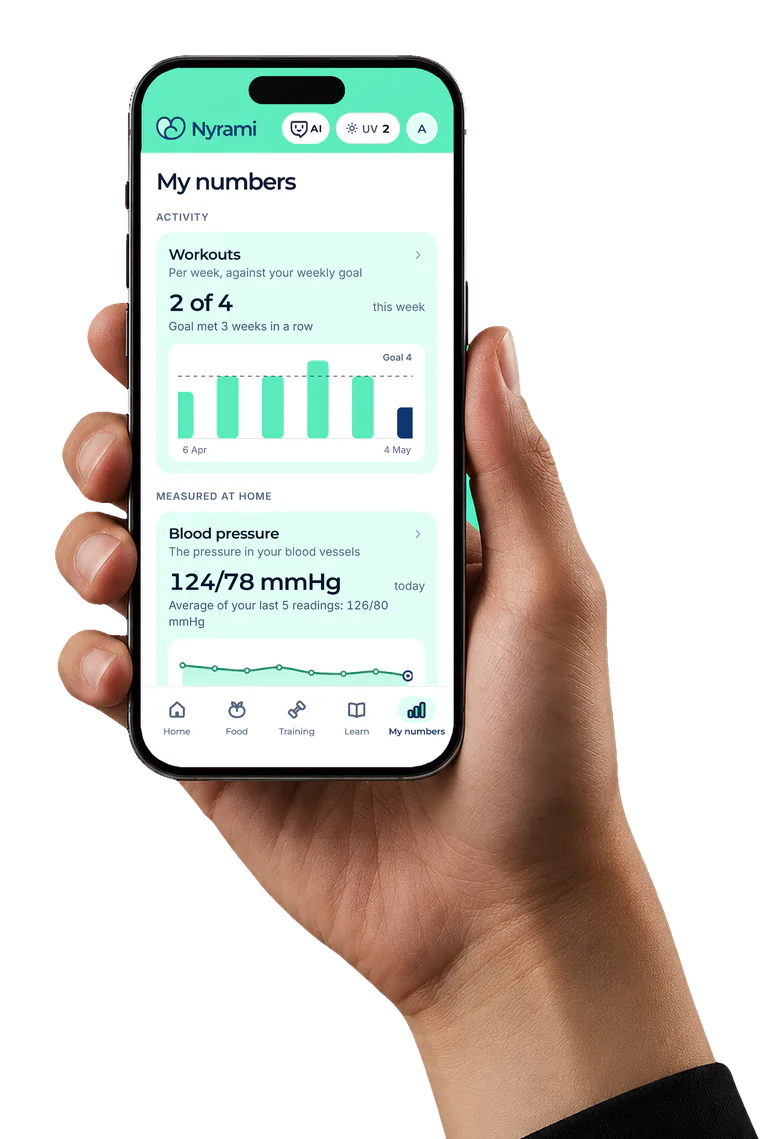
The food scanner in the Nyrami app reads the barcode and assesses sodium for you, so you see the salt without converting. The recipes in the app are assessed per portion, and you can follow your blood pressure over time. The app is free for iPhone and Android.
Turns the advice into something you can use in the shop and the kitchen: scan food and see potassium, phosphorus and salt assessed for you, and follow your numbers over time. Free on iPhone and Android.