Kidney transplant: waiting times, survival and life after
For many people with severe kidney failure, a new kidney is the best treatment. All kidney transplants in Norway are done at Rikshospitalet in Oslo. The wait for a kidney from a deceased donor is about two years, and most kidneys work for many years, but you need anti-rejection medicines for life.
A kidney transplant means you receive a healthy kidney from another person, either from a living donor or from a deceased donor. It does not give you back a completely ordinary body, but for many people it means a life without dialysis and with far more energy. Here is what you and your family need to know, from the assessment to life afterwards, with Norwegian figures.
Who can get a new kidney?
Anyone with severe kidney failure can be assessed for a new kidney, including before they have started dialysis. Norway has no fixed upper or lower age limit. What decides it is whether you will benefit from a new kidney and can cope with the operation and the medicines afterwards. Other serious illness is the most common reason why someone is not transplanted.
Not everyone is offered one. Among those who started dialysis in 2024, just over four in ten were assessed as suitable for a new kidney, and almost two in ten more as possible candidates. At the same time, more than 1,100 people in Norway have received a new kidney after the age of 70, and the oldest was 84. One in four of those who received their first new kidney in 2024 avoided dialysis altogether (Norwegian Renal Registry).
What happens during the assessment?
The assessment takes place at your local hospital and looks for disease of the heart, blood vessels and lungs, and rules out cancer. Among other things you will have a chest X-ray, heart tests, a lung function test and blood and urine tests. If you are over 40, you will also have a CT or MRI scan of the main artery and the blood vessels in the pelvis. You will see a dentist and a social worker. Once you are approved, you are put on the waiting list, or you plan the operation if you have a living donor.
How long is the wait for a new kidney?
People who received their first kidney from a deceased donor in 2024 had waited about two years (median about 23 months), according to the Norwegian Renal Registry. Ten years earlier the wait was about half as long. One in four waited less than about a year, and one in four waited more than about three years. With a living donor, the wait is shorter and more predictable.
The waiting list keeps growing. At the end of 2025, 548 people were waiting for a kidney, including those temporarily taken off the list (Stiftelsen Organdonasjon, the Norwegian organ donation foundation).
Time on the list is not the only thing that decides who gets a kidney. First, blood type and tissue type must match, and you should not have antibodies against the donor's tissue. Then age and size are considered, and only then how long you have waited. If you have many antibodies, it can take longer to find a kidney that matches, but you then get priority in the exchange of kidneys within Scandinavia. If you are temporarily taken off the list for less than two years, for example because of illness or travel, you keep the waiting time you have built up (LNT, the Norwegian association for kidney patients and transplant recipients).
Living or deceased donor: what is the difference?
A kidney from a living donor usually starts working sooner and generally lasts longer than a kidney from a deceased donor. The operation can be planned, the kidney is outside the body for a short time, and the donor is a healthy person who has been thoroughly examined. Both are good treatment, and most people in Norway receive a kidney from a deceased donor.
Norway has many living donors. In 2024, 255 kidney transplants were carried out, and 71 of the kidneys came from living donors (Norwegian Directorate of Health). In 2025, 70 people gave a kidney to a family member or close friend (Stiftelsen Organdonasjon). If someone in your family is thinking about giving you a kidney, you can read Donating a kidney: what it is like to be a living donor.
How is the operation done, and how long do you stay in Oslo?
All kidney transplants in Norway are carried out at Oslo University Hospital, Rikshospitalet. The operation takes about four to five hours under general anaesthetic. The new kidney is placed low in the abdomen, on the right or left side, and connected to the blood vessels in the pelvis and to the bladder. Your own kidneys are usually left in place.
After the operation you spend about a day in the high dependency unit. Without complications you are discharged from the ward after 7 to 10 days. For some people it takes days or weeks before the kidney works well, and you may need dialysis for a while. If you have a living donor, you are both admitted two to four days before the operation.
For the first eight weeks most people attend check-ups at Rikshospitalet three times a week, because the risk of rejection and infection is highest then. If you live close enough, you can stay at home. If you live far away and can manage on your own, you stay at a hotel with a private room and meals. After that your kidney specialist at your local hospital follows you up, at first twice a week and after a couple of years every month or every other month.
How long does a transplanted kidney last?
A transplanted kidney often lasts many years, but not always for the rest of your life. In Norway almost nine in ten transplanted kidneys were still working after ten years, when people who died with a working kidney are left out. The person in Norway who has had their new kidney the longest still had it working after 55 years (Norwegian Renal Registry).
Share living with a working kidney, after transplants in Norway 2007 to 2024
5 years
Kidney from a living donor
About nine in ten
Kidney from a deceased donor
About eight in ten
10 years
Kidney from a living donor
About three in four
Kidney from a deceased donor
About half
15 years
Kidney from a living donor
Just over half
Kidney from a deceased donor
About three in ten
Share living with a working kidney, after transplants in Norway 2007 to 2024
Time after the transplant
Kidney from a living donor
Kidney from a deceased donor
5 years
About nine in ten
About eight in ten
10 years
About three in four
About half
15 years
Just over half
About three in ten
Source: Norwegian Renal Registry, annual report 2024 and slide pack. Read from curves and rounded. The figures also count people who died with a working kidney, and those who receive a kidney from a deceased donor are older on average. When deaths are left out, the difference between the two is small.
These figures describe groups, not you. Your age, other illnesses, how well the kidney matched and whether you take your medicines correctly all matter a great deal. If the kidney stops working, you can go back to dialysis and possibly have another transplant. About one in eight kidney transplants in 2024 was a repeat transplant for someone who had had a kidney before. Cristian received his first new kidney in 2006. It worked for nine years, and in 2021 he received another.
What is life like after a kidney transplant?
After a successful transplant most people get close to normal kidney function. Many of the problems from kidney failure and dialysis disappear, and many go back to work or study. At the same time you have to take medicines every day for the rest of your life, attend regular check-ups and take some precautions. The first months can have ups and downs, and it is common to feel both relief and worry.
Anti-rejection medicines
To stop your body rejecting the kidney, you need to take several immunosuppressive medicines for as long as the kidney works. The most common combination in Norway is tacrolimus (Prograf, Advagraf) with mycophenolate (CellCept, Myfortic) and prednisolone. Some people use ciclosporin, everolimus or belatacept instead. Doses are highest in the first months and are reduced over time. Do not stop or change your medicines yourself, and tell your doctor and pharmacy that you have had a transplant before you start anything new, including over the counter and herbal products.
Infections and vaccines
The medicines make you more prone to infections, especially in the early period. Good hand hygiene and good mouth care help. You must not have live vaccines, and Rikshospitalet advises waiting until six months have passed before having vaccines. The flu vaccine is recommended.
Skin and sun
Immunosuppressive medicines increase the risk of skin cancer. Use sunscreen of at least factor 30, stay in the shade in the middle of the day and avoid sunbeds. Show new or changing spots and sores that do not heal to your doctor, and see a dermatologist regularly.
The medicines can also cause high blood sugar, weight gain, high cholesterol and weaker bones. About one in ten develop diabetes after the transplant. That is why physical activity is an important part of treatment. See Exercise with kidney disease.
What are the signs of rejection?
Rejection often causes no signs at first and is usually picked up in blood tests at your check-ups. That is why it is so important to attend them. One to two in ten have a rejection episode in the first year, most often one to three weeks after the operation. After three months it is relatively rare. Rejection is treated, and some people need dialysis for a short time during treatment.
Contact the hospital or the doctor who follows you up if you notice:
A temperature above 38°C and you feel unwell, or a temperature that stays just below 38°C.
Less urine than usual.
Rapid weight gain or swelling in your legs, feet or hands.
Pain or tenderness over the new kidney.
Flu-like symptoms, unusual tiredness or higher blood pressure than usual.
A fever can also mean an infection, and after three months that is the most common cause. The medicines can dampen a fever, so take it seriously even if your temperature is not high. If you cannot reach the hospital, call the out of hours service (legevakt) on 116 117, or 113 if it is life threatening.
What can you eat and drink after the transplant?
Most people can eat a more varied diet than during dialysis. In the first one to two months you need extra energy and protein. After that, an ordinary heart healthy diet with little salt is recommended, because the medicines increase the risk of weight gain, diabetes and heart disease. Whether you still need to watch potassium or phosphorus depends on how well the new kidney works, so ask your doctor. Rikshospitalet advises 1.5 to 2 litres of fluid a day, preferably water, unless your doctor has told you otherwise.
Some food and drink affect the medicines:
Grapefruit and grapefruit juice can raise the level of immunosuppressive medicine in your blood too much. Pomelo, star fruit, Seville orange and pomegranate juice can have the same effect.
St John's wort weakens the effect of the medicines. Ask before taking herbal remedies.
Because your immune system is suppressed, you are also more prone to food-borne infections. The advice from the Norwegian Institute of Public Health includes choosing pasteurised dairy products, heating soft ripened cheeses such as brie and camembert, cooking poultry and minced meat thoroughly, avoiding raw meat, cured meats and rakfisk (fermented fish), and boiling raw sprouts and imported frozen berries. Ask your doctor how long the advice applies to you.
Alcohol after a kidney transplant
Both alcohol and the immunosuppressive medicines are broken down in the liver. Rikshospitalet advises waiting with alcohol until the doses have been reduced after the first three months, and then keeping to moderate amounts. Heavy drinking does not go with a new organ: it can cause high blood pressure and liver damage, and make it easier to forget your medicines. See also Alcohol and the kidneys.
What should the family know?
A transplant affects the whole family. According to Oslo University Hospital, relatives can stay with you at the hotel in Oslo, but they must pay for their own travel and stay. If your doctor confirms that you need someone with you for health reasons, Pasientreiser (patient travel) can cover a companion's journey. It is no longer possible to stay at Gaustad hotel at Rikshospitalet. The hospital arranges accommodation elsewhere instead, including at Ullevål hotel and Hotell Montebello, and the ward helps with booking.
Children react in different ways when a mother, father or sibling travels to Oslo for a transplant. Include them in what is happening, and let the nursery or school know. The time afterwards also takes adjusting to: when someone who has been ill for a long time gets better, roles in the family change, and that takes time for everyone.
LNT (the Norwegian association for kidney patients and transplant recipients) has peer supporters who have had a transplant themselves, have given a kidney or have been a relative. Read more about being a family member of someone with kidney disease.
How Nyrami can help
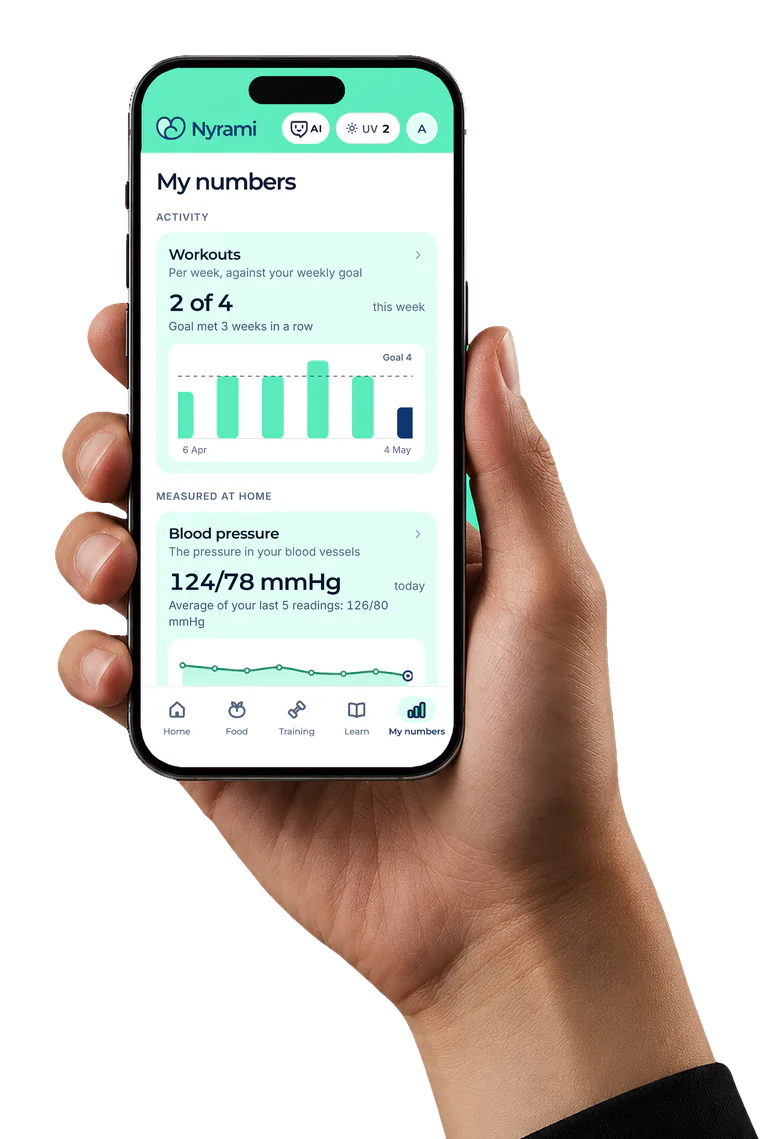
In the Nyrami app you can follow your values after the transplant, such as eGFR, creatinine, blood pressure and weight, over time, so you see the trend between check-ups and know what to ask about. The recipes are assessed per portion, and the workouts with video suit you when you are building yourself up again. The app is free to download for iPhone and Android.
Turns the advice into something you can use in the shop and the kitchen: scan food and see potassium, phosphorus and salt assessed for you, and follow your numbers over time. Free on iPhone and Android.